

BSC Research Demonstrates How AI Improves Modeling of Complex Fluid Simulations
Jan. 20, 2026 — Simulations of turbulent flows are essential in fluid mechanics because they help scientists understand and predict complex movements of air and liquids, such as airflow around airplanes, wind in cities, or water in rivers. However, these computational models generate enormous amounts of “noisy” data that make it difficult to extract useful information and reuse it efficiently.
Image credits: BSC
Addressing this long-standing challenge, researchers at the Barcelona Supercomputing Center – Centro Nacional de Supercomputación (BSC-CNS) have developed an artificial intelligence-based methodology that filters out this noise and retains only the most relevant flow patterns. By representing complex turbulence in a much simpler and more stable way, the approach makes it possible to analyze and predict flow behavior in less time and at a significantly lower computational cost.
The study was led by Rakesh Halder, researcher in the Large-scale Computational Fluid Dynamics group at BSC, with Oriol Lehmkuhl, leader of the same research group, and Benet Eiximeno, former BSC researcher. The article has been selected as an Editors’ Pick by Physics of Fluids, a distinction given to papers considered particularly noteworthy by the editors within each issue of the journal.
High-fidelity fluid simulations are widely used to study turbulent flows in applications ranging from aerodynamics and transport to industrial design, helping predict wind effects on buildings and bridges, and optimize the design of turbines and other energy systems. However, the chaotic nature of small-scale turbulent structures makes these simulations extremely computationally demanding and limits their use in real-time analysis or design optimization processes.
Model Based on AI
To overcome these limitations, the researchers developed a reduced-order model based on artificial intelligence. The method combines variational autoencoders, a deep learning technique, with Koopman theory to learn a simplified representation of turbulent flows. This allows the model to focus on large-scale flow patterns while automatically filtering out small-scale fluctuations that are difficult to predict over long time horizons.

“The goal is not to predict all scales of turbulence, but to accurately capture the dominant flow behavior that is most relevant for engineering applications. This makes it possible to build surrogate models that are much more tractable, reducing computational costs while still providing reliable predictions”, says Rakesh Halder.
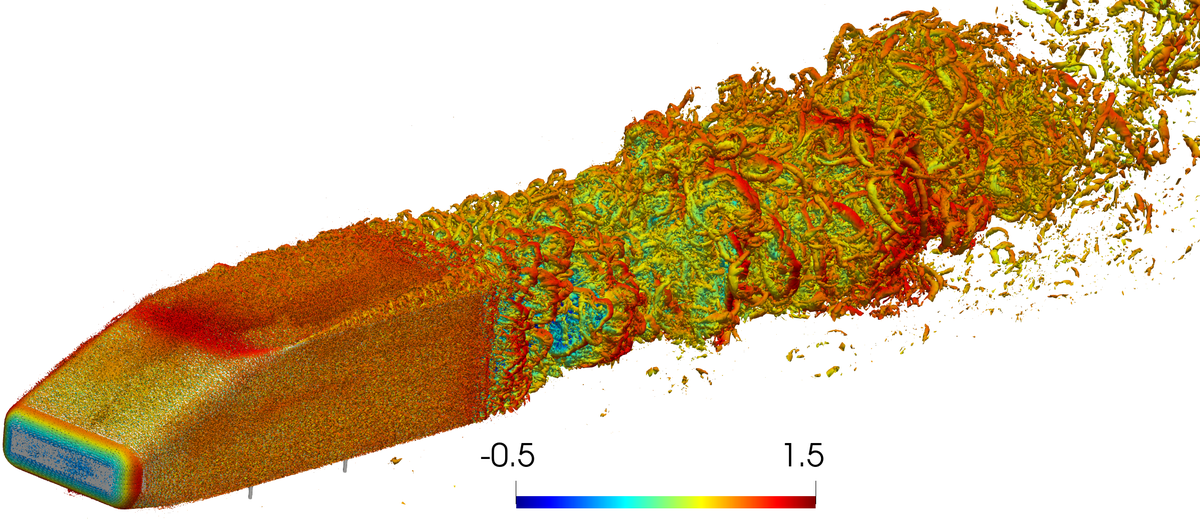
The approach was tested on simulations of turbulent airflow around a vehicle-like geometry under different conditions. The results show that the AI-based model preserves key large-scale flow features and remains stable over time, making it a promising tool for fast and reliable flow analysis.
According to the researchers, future work will focus on extending the method to more complex geometries and three-dimensional flows, further broadening its potential applications in scientific research and industrial contexts.
Reference: Halder, R., Eiximeno, B. and Lehmkuhl, O., 2026. Reduced-order modeling of large-scale turbulence using Koopman β-variational autoencoders. Physics of Fluids, 38(1). https://doi.org/10.1063/5.0293452
Source: BSC
Related

