

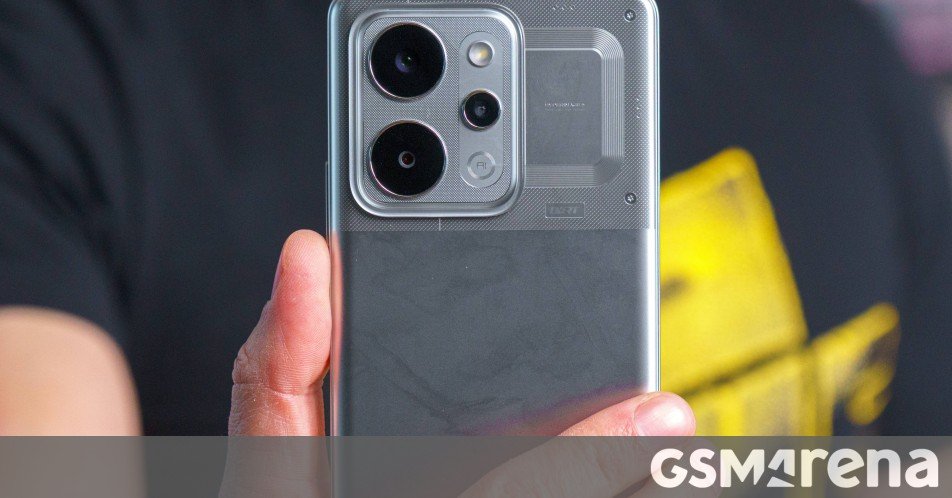
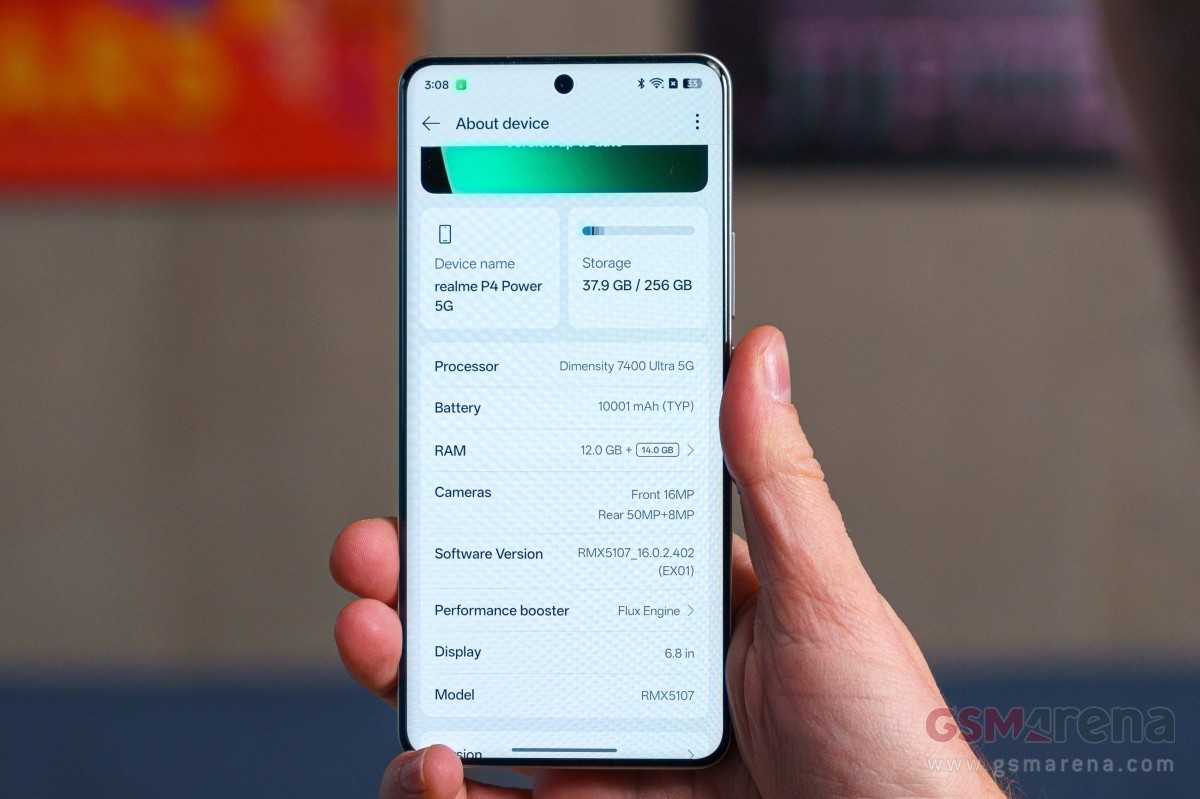
We’ve been working on our Realme P4 Power review and after a quick detour to try out its performance as a power bank, we are back to our regular tests. Without question, the 10,001mAh battery is the highlight feature of the phone, so that’s where we turn to next.

It’s not that we haven’t seen phones with similar or even bigger batteries before – it’s just that this one is the first one we have tested that doesn’t feel like a brick. It measures 162.3 x 76.2 x 9.1mm and weighs 219g, which is pretty standard for a phone with a 6.8” display.
The 10,001mAh battery uses next-gen Silicon-Carbon technology that promises to last 8 years of use (retaining at least 80% of its original capacity after 1,650 charge cycles). Modern Si-C tech is incredible, isn’t it? You could limit the battery to between 80% and 95% (in 5% increments), but there is little reason to do so – 8 years is a long time and a 10,001mAh battery at 80% health is still a large battery.
The Realme P4 Power deserves applause – it topped our battery chart with a solid lead over the #2 phone. If you look at the chart, you will see that it’s mostly premium phones near the top. We’re not going to include those here since the P4 Power isn’t a premium model by any means, but we will include the current #5 model, the OnePlus 15R (which still costs 70% more than the Realme).
The Realme P4 Power achieved an impressive 25:35 Active Use Score. There are the likes of the Honor Win and OnePlus Turbo 6 with large batteries of their own, but we haven’t tested those yet. Instead, we’ve included a few 7,000+ mAh models that we have tested – and most can’t compete.
We mentioned the OnePlus 15R above – it has a 7,400mAh battery. It did very well for itself with a score of 21:36. The Realme 16 Pro+ also deserves some praise – while its gaming time (8:53h) is pretty bad given its 7,000mAh battery, the 21:18h web browsing score is better than most.
The Moto Edge 60 has a 5,200mAh battery, which is just over half of the capacity of the Realme P4 Power. With that in mind, the scores aren’t bad, though this isn’t the phone to get if you want to go two days between charges. The Realme P3 Ultra is P4 Power’s predecessor and it only has a 6,000mAh battery. This goes to show how quickly battery tech is evolving.
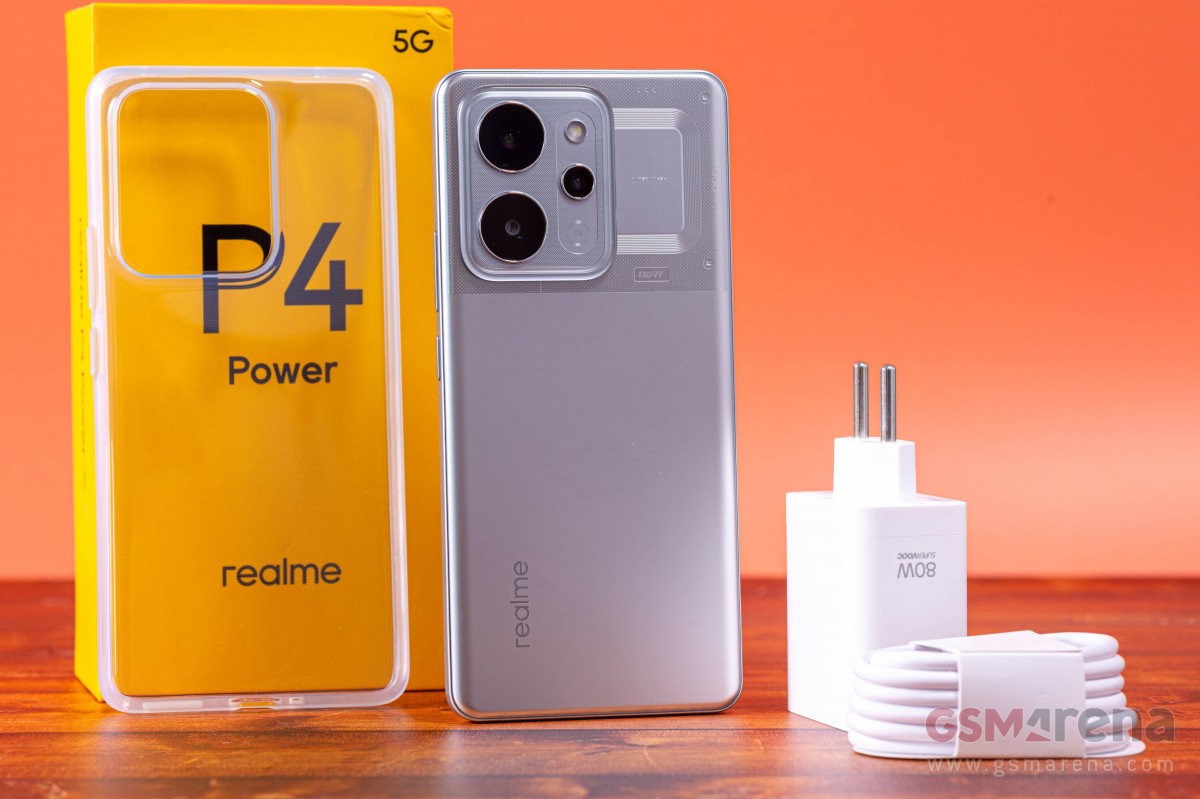
Large batteries need fast charging support to be practical and the Realme P4 Power supports 80W SuperVOOC and 55W USB PPS. We used an 80W SuperVOOC charger for this test.
Given that it has a much larger capacity than other phones on this list, we knew that charge times would be slow. But they are not the slowest, which is all that we could have asked for. In fact, after 15 minutes, the phone hit 27% – matching the Redmi Note 15 Pro, which only has a 6,580mAh battery (and slower 45W charging).
By the 30 minute mark, the P4 Power starts to lag behind the pack. That said, 45% charge is enough to get you through the day and you get that in half an hour. If you prefer to charge to full, you will need 79 minutes. That’s just 9 minutes longer than the Honor Magic8 Lite (7,500mAh, 66W) and 26 minutes slower than the OnePlus 15R, which also uses 80W SuperVOOC (don’t forget that its battery is 2,600mAh smaller or that it has a higher price tag).
The most direct comparison is with the Realme P4 Pro, which costs exactly the same as the P4 Power – ₹30,000 for an 8/256GB unit on Realme India – and has the same 80W SuperVOOC charging system. The difference between its 7,000mAh battery and Power’s 10,001mAh battery is 27 minutes longer to 100% charge.
We have more tests to run on the Realme P4 Power, so stay tuned for the full review. If you like what you see, Realme India starts selling the Power on February 5.
