

ABB Robotics and Nvidia have announced a partnership to improve how industrial robots are designed, trained and deployed in manufacturing environments. The collaboration involves integrating Nvidia’s Omniverse simulation libraries into ABB’s RobotStudio engineering software to create a new offering called RobotStudio HyperReality, scheduled for release in the second half of 2026.
RobotStudio is used by robotics engineers to design and program automation systems. According to ABB, more than 60,000 engineers use the platform to build and simulate robotic production lines. By adding Omniverse libraries, the company plans to add more realistic simulation and synthetic data generation capabilities, allowing manufacturers to test and train robots in digital environments before they hit factory floors.
Robotics researchers have sought solutions for the “sim-to-real gap,” or the difference between how robots behave in computer simulations and how they perform in the complex and unpredictable conditions of the real world. Different lighting conditions, material properties and environmental factors can cause robots trained in simulation to behave inconsistently when deployed.
An example of a simulated industrial environment in Omniverse (Image courtesy of Nvidia)
The Omniverse/RobotStudio integration is meant to narrow that gap by combining ABB’s virtual robot controller, or a software replica of a robot’s real control system, with Nvidia’s physically accurate simulation environment. The virtual controller runs the same firmware as ABB’s physical robots, which the companies say allows motion paths and task performance tested in simulation to translate more closely to real-world operations.
RobotStudio exports a fully parameterized robot station, including robots, sensors, lighting, kinematics and parts, as a USD file that can be loaded into Omniverse. Synthetic images generated in the simulation environment can then feed directly into AI training pipelines, allowing vision models to be trained in virtual environments. According to ABB, this approach allows manufacturers to design, test and validate automation systems virtually before installing physical hardware. The company claims the process could reduce production line setup times by as much as 80% and lower deployment costs by up to 40% by eliminating the need for physical prototypes during early development stages.
The partnership highlights the robotics industry’s move toward AI-driven systems that are capable of managing more complex tasks. During a briefing announcing the collaboration, Deepu Talla, VP of robotics and edge AI at Nvidia, explained the shift: “Just as AI moved from basic recognition to deep thinking, robot intelligence is changing too,” he said. “Today, most robots are specialists. They are excellent at one single task, but they cannot adapt to anything else because they are preprogrammed. The future belongs to generalist specialist robots. Think of them as the PhDs of the robot world, combining broad knowledge with deep expertise.”
Talla says building these advanced robots requires an open development platform involving three computing environments: infrastructure to train AI models, simulation platforms where robots can be tested virtually, and computing systems that run those models on physical machines. Nvidia’s role in the partnership focuses on the simulation layer, while ABB covers the industrial robotics platforms and development tools used by manufacturers.

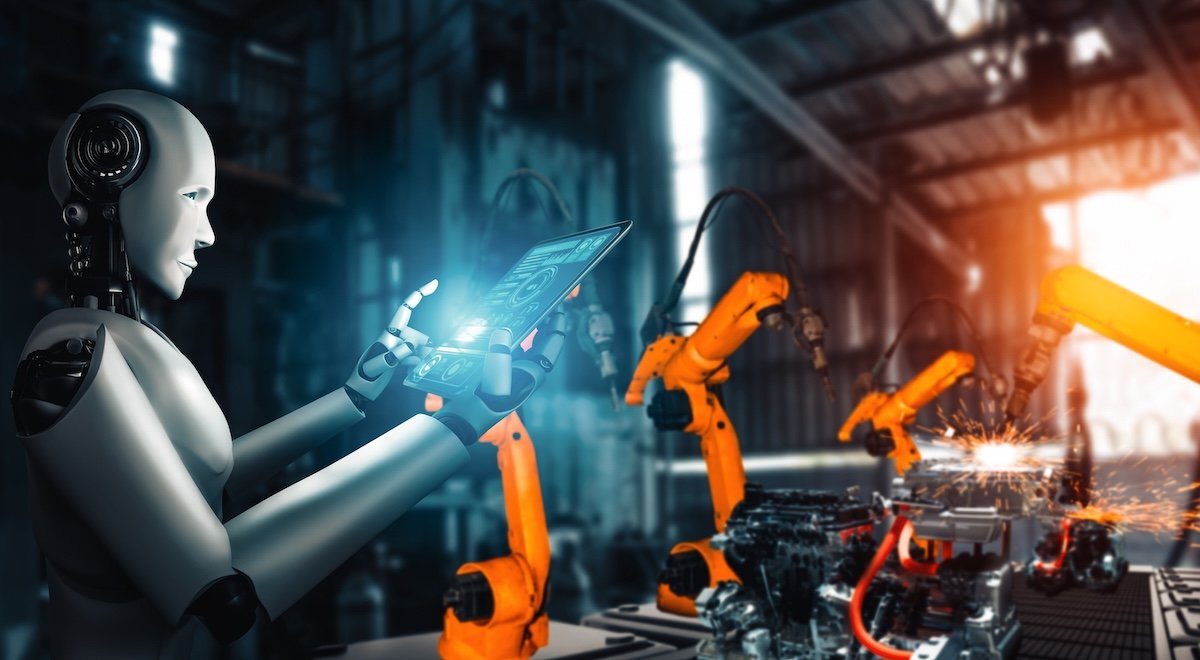
(IM Imagery/Shutterstock)
Several companies are already experimenting with the system in pilot projects. Electronics manufacturer Foxconn is testing the system for consumer electronics assembly. The company plans to train assembly robots in simulation using synthetic data before transferring those models to real production lines. Another pilot involves Workr, a California-based robotics company that develops automation systems for small and mid-sized manufacturers. Workr is integrating its WorkrCore platform with ABB robots trained using synthetic data generated through Omniverse. The company plans to demonstrate the system at Nvidia’s GTC conference next week.
ABB also said it is exploring the possibility of integrating Nvidia’s Jetson edge AI platform into its Omnicore robot controller. This integration would allow industrial robots to run AI models directly on their controllers, with the goal of enabling real-time perception and decision making without relying on external computing systems.
The companies said the new capabilities could make advanced robotics more accessible beyond traditional large-scale manufacturing. Historically, robots have been most widely adopted in high-volume production settings such as automotive assembly. ABB and Nvidia say improvements in simulation and AI may allow automation to expand into smaller manufacturing environments where production runs are more varied and programming costs have traditionally limited robotics adoption.
ABB said RobotStudio HyperReality will be offered as a subscription product when it launches in the second half of 2026. The company currently provides a free version of RobotStudio with basic functionality, while its industrial users typically access the more advanced RobotStudio Premium through a subscription model.
ABB Robotics President Marc Segura said during the briefing that what makes the partnership unique is the unified platform created by combining RobotStudio with Nvidia’s Omniverse: “We are offering a platform where you can close the sim-to-real gap at industrial grade. With our RobotStudio and our virtual controller, we have for years been the reference for simulating something in a computer and deploying it with high accuracy in a robot. Now with Nvidia, we’re enhancing that and expanding that beyond the robot and the environment.”
This article first appeared on HPCwire.
The post Nvidia and ABB Robotics Combine Simulation and AI to Train Industrial Robots appeared first on AIwire.
