

Argonne Receives DOE Funding to Advance AI for Science
Part of the Genesis Mission, these awards enable Argonne to conduct transformative AI research
March 12, 2026 — The U.S. Department of Energy’s (DOE) Argonne National Laboratory was awarded funding for more than a dozen research projects that aim to advance the use of artificial intelligence (AI) to enable scientific breakthroughs.
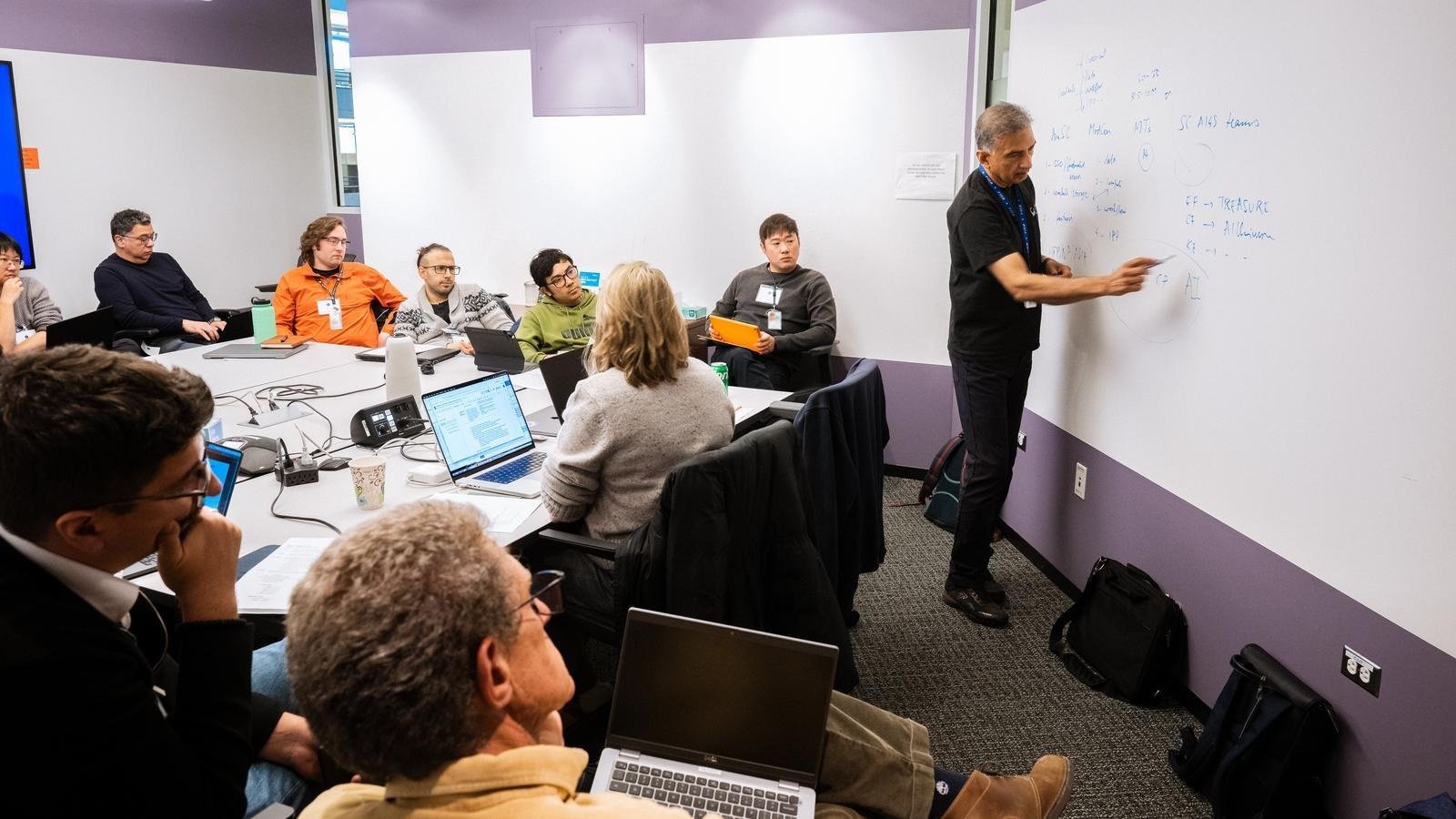
The primary objective of the onsite Transformational AI Models Consortium (ModCon) Hackathon is to bring together all Consortium members, Model Teams (MTs), and external partners to establish a collaborative foundation that drives delivery toward the March deliverables.
The funding from DOE is part of its investment in the Genesis Mission, a national initiative to use transformative AI capabilities to accelerate discovery science, strengthen national security and drive energy innovation. The Genesis Mission aims to develop an integrated platform that connects the world’s best supercomputers, experimental facilities, AI systems and datasets across every major scientific domain to double the productivity and impact of American research and innovation within a decade.
Argonne was awarded funding to lead the Genesis Mission’s Transformational AI Models Consortium (ModCon). The cornerstone of the Genesis Mission’s AI models and data efforts, ModCon will build and deploy self-improving AI models by harnessing DOE’s unique data, facilities and expertise. Selected teams will develop foundational capabilities needed across multiple scientific and engineering domains. ModCon is led by Rick Stevens, associate laboratory director for Argonne’s Computing, Environment and Life Sciences division. Argonne researchers are involved in a range of ModCon projects.
Argonne is participating in the American Science Cloud (AmSC), the foundation of the Genesis Mission’s integrated platform, which is led by DOE’s Oak Ridge National Laboratory (Oak Ridge). Argonne is a partner in designing and developing infrastructure to support next-generation AI and simulation workflows. In addition, the computing resources at the Argonne Leadership Computing Facility, a DOE Office of Science user facility, are supporting Genesis Mission research projects.
Argonne also received funding for research that leverages AI, automation and robotics in scientific experiments and foundational AI projects that curate data and develop AI models.
Following is a list of projects that received funding:
- AI-Assisted Multiscale Modeling of Radiation Damage in Fusion Materials, led by Paul Romano – Research that uses AI to better understand how fusion reactor materials degrade under intense neutron radiation.
- AlphaFold for Microelectronics, led by Subramanian Sankaranarayanan – Just as AlphaFold transformed biology by predicting protein’s 3D shape from its genetic code, this physics-based AI framework will predict how tiny flaws emerge and evolve inside materials and how those changes impact how a device functions.
- Foundation Models Orchestrating Reasoning Agents to Uncover Materials Advances and Insights (FORUM-AI) – A project to develop an AI research planner for materials science papers, capable of breaking down complex scientific questions into actionable steps; a registry of AI reasoning agents to carry out specialized tasks; and a unified framework that grounds AI model predictions in real-world data. Maria Chan is on the team led by DOE’s Lawrence Berkeley National Laboratory (Berkeley).
- HEP AmSC IDA Pilot: Knowledge Extraction, led by Katrin Heitmann – An integrated framework to find new physics insights from legacy and varied high energy physics (HEP) datasets. Heitmann, along with Andrew Hearin, is also the Argonne point of contact for an additional HEP project: “HEP AmSC IDA Pilot: AI Universe,” led by Berkeley.
- Integrated Agentic AI for Catalysis (ISAAC) – Agentic AI tools that leverage different types of data from scientific user facilities – such as X-ray and neutron measurements and physics simulations – to discover how catalytic reactions happen. Maria Chan is on the team led by DOE’s SLAC National Accelerator Laboratory.
- Intelligent Design Assistant for Enzyme Discovery and Biosynthetic Pathway Optimization (IDeA), led by Arvind Ramanathan – An AI “co-scientist” that helps scientists discover and design enzymes much faster than today’s trial-and-error methods, enabling cleaner and more efficient bio-manufacturing.
- LAMBDA: A Lakehouse-enabled AI-ready Multi-modal Bioimaging Data Architecture – A cross-facility, standardized data framework for all structural biology and imaging resources supported by DOE’s Office of Science, Biological and Environmental Research program. Dion Antonopoulos and Gyorgy Babnigg are on the team led by Berkeley.
- MIRAGE: Microstructure Insights through Reliable/Interpretable AI and Guided Experiments – A multi-lab project that uses AI to understand how materials wear down and even self-heal at the nanoscale. Mathew Cherukara, Jeff Larson and Todd Munson are on the team led by DOE’s Sandia National Laboratories.
- Next-Generation Data Quality Monitoring: AI Solutions for High-Energy Physics Experiments, led by Walter Hopkins – A cross-experiment AI framework that modernizes data quality monitoring for HEP experiments. Hopkins is also the Argonne point of contact and an active participant of an additional HEP project “Hunting for TREASURE in HEP Collider Data,” led by DOE’s Brookhaven National Laboratory (Brookhaven).
- OPAL: Orchestrated Platform for Autonomous Laboratories to Accelerate AI-Driven BioDesign – A multi-laboratory initiative to make biological discovery more automated. Argonne is pioneering an approach to protein design that integrates AI with advanced robotics, connecting computer-designed proteins with real-world lab testing. The Argonne project is led by Dion Antonopoulos. Other partners are Berkeley, Oak Ridge and DOE’s Pacific Northwest National Laboratory.
- Preparing QCD Data for Foundation Model – This project is curating complex experimental data from particle accelerator facilities into standardized, AI-ready, machine-readable formats suitable for AI training. Ian Cloet is on the team led by Brookhaven.
- Robot Scientific Assistants for Accelerating Experimental Workflows (RoSA), led by Nicola Ferrier – Aimed at developing a robot scientific assistant, this project collects data from human scientists to train learning models and build a classification of lab tasks, leading to improvements in safety and efficiency.
- STREAMLINE Collaboration: Machine Learning for Nuclear Many-Body Systems – Creating faster, lower-cost computer tools to handle highly complex nuclear physics calculations while also building an AI-capable scientific workforce. Alessandro Lovato is on the team led by Michigan State University.
Scientific Discovery through Advanced Computing (SciDAC) institutes:
- Frameworks, Algorithms, and Scalable Technologies for Mathematics (FASTMath) – FASTMath will develop mathematical techniques and algorithms to model complex physical systems, leading to faster and more accurate scientific computations that can be used on DOE supercomputers. Todd Munson is FASTMath deputy director and Jeff Larson is the Argonne institutional lead. This project is led by DOE’s Lawrence Livermore National Laboratory.
- The RAPIDS3 Institute for Artificial Intelligence, Computer Science, and Data, led by Rob Ross – This SciDAC institute focuses on making scientific software run faster and use less energy, manage and understand the massive volumes of data from modern simulations and experiments, and speed up discovery using AI and machine learning.
Source: Julie Parente, Argonne
Related

