

Nvidia CEO Jensen Huang pulled the covers back a bit on the GPU giant’s roadmap during his keynote at the GTC show this week. Nvidia plans to build a host of new chips to address insatiable demand for compute, including new GPUs, CPUs, LPUs, and DPUs. The company is also making a big push into silicon optics, including to build a scale-up NVLink system with more than 1,000 GPUs.
The chips, racks, and systems are flying out of Nvidia these days as the AI boom continues to build. Yesterday the GPU giant revealed the seven new chips at GTC, which includes the Rubin GPU, the Vera CPU, a Groq language processing unit (LPU), BlueField-4 data processing units (DPUs), NVLink 6 Switch, ConnectX-9 SuperNICs, and SpectrumX Photonics, a co-packaged optics (CPO) Ethernet switch unveiled at GTC25. It also revealed new NVL systems, a slew of new MGX racks for Vera, Groq, and DPUs, as well as a new supercomputer that combines various Nvidia MGX racks in a Pod configuration.
But over the next two years, Nvidia will roll out a slew of new chips, systems, and MGX rack systems. Huang shared during his GTC keynote. For starters, Nvidia plans to roll out Rubin Ultra later this year. We’ll also see another Groq LPU chip, the LP35, which is designed for low-precision 4-bit NVFP4 AI workloads.
Feynman, which is the next generation of Nvidia’s GPU, will debut in 2028 and feature die stacking and a custom HBM, Huang said. Nvidia is also developing a version of the Groq LPU that plugs into NVLink, the LP40. The follow-on to the Vera CPU will be called Rosa. There’s also a BlueField-5 DPU in the works and CX10 SuperNIC.
Nvidia CEO Jensen Huang shared this roadmap during his keynote at GTC26
In 2028, we’ll also see NVLink8 CPO, a co-packaged optic ASIC that brings silicon photonics to Nvidia’s scale-up NVLink interconnect. We’ll also see Spectrum7 204T, the next version of its CPO switch for scale-out Ethernet deployments.
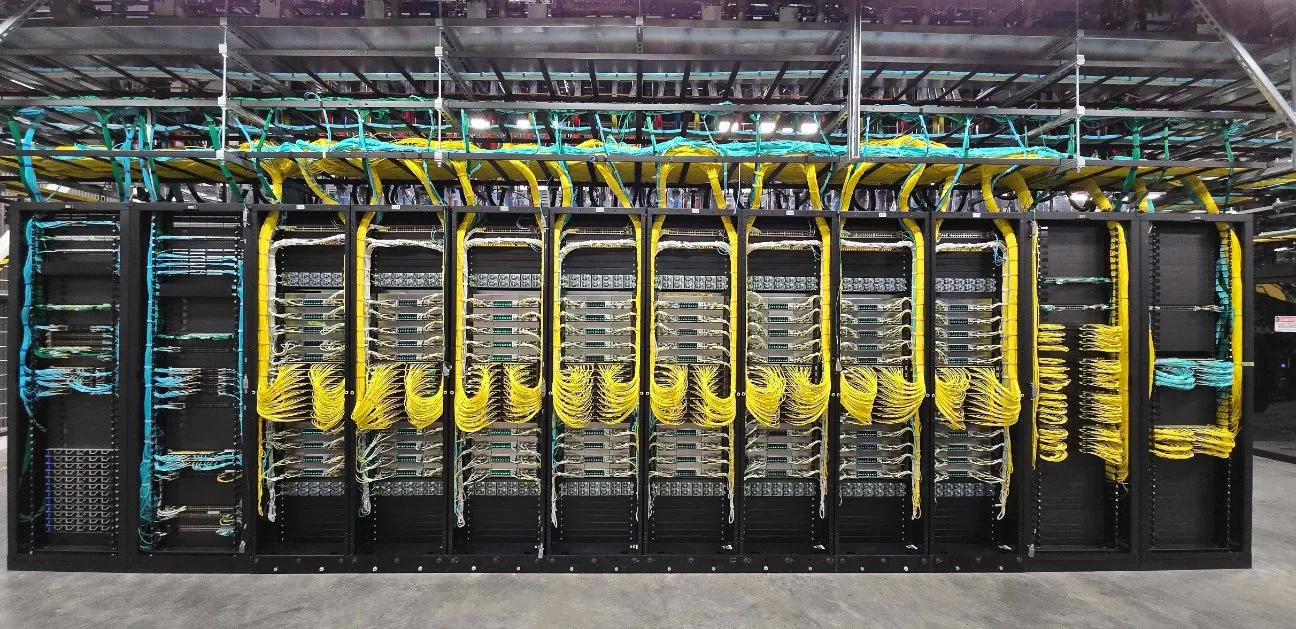
Huang is fond of saying that Nvidia is not a GPU company, but an AI factory company. To that end, the company is rolling out new racks, including NVL72 based on the Vera Rubin superchip. With the launch of Rubin Ultra, we’ll also see an NVL576 “Oberon” system, which combines “eight separate MGX NVL racks, each with 72 Rubin Ultra GPUs, all in a single 576-GPU NVLink domain with copper and direct optical connections,” the company said in a blog post this week. Nvidia is demonstrating this NVL576 Oberon system with Polyphe, a prototype of a GB200 multi-rack NLV576 system (see feature image above).
Nvidia also touted the MGX NVL, which are new “Oberon” generation racks designed to provide scale-up capability based on its NVL interconnect. It’s also launching MGX ETL racks, which provide scale-up racks in the MGX form-factor but featuring a Spectrum-X Ethernet spine (or a direct chip-to-chip spine).

Nvidia Kyber NVL1152 (Image courtesy of Nvidia)
Nvidia is in the process of moving to the next-generation “Kyber” systems as the follow-on to Oberon. Kyber will first be introduced with Vera Rubin Ultra as a standalone NVL144 system, and eventually it will provide customers with three options for Vera Rubin Ultra NVLink scale-up domains, including NVL72, NVL144, and the flagship NVL576.
Eventually Nvidia will take it all up a notch with Kyber NVL1152, which is “the next-generation MGX NVL rack design that will double the NVLink domain per rack to fit 144 GPUs,” Nvidia said in its blog. “Kyber will scale up into a massive all-to-all NVL1152 supercomputer using similar direct optical interconnects for rack-to-rack scale-up.”
Silicon photonics looms heavy over the computer industry, which is rapidly awakening to the realization that the physical limits of copper will soon be reached, if they haven’t already. While copper-based electrical connections have taken us very far, copper has limits when it comes to speed, latency, reach, and energy. The benefits of silicon photonics have long been known, but the costs and complexity were typically too high to justify using it.
Nvidia is already in production with Spectrum-X Photonics, which is co-packaged optics (CPO) Ethernet switch unveiled at GTC25 that connects GPUs and memory over glass strands with up to 400 Tb per second of throughput in a scale-out manner. The company also announced the Quantum-X Photonics InfiniBand switch, which delivers up to 800 Tb per second of scale-out throughput using its proprietary scale-out interconnect.

Nvidia Quantum-X (left) and Spectrum-X photonics chips (Image courtesy of Nvidia)
Nvidia invested $4 billion in a pair of silicon photonics companies two weeks ago, including Lumentum and Coherent. It also has investments in other silicon photonics outfits, including Scintil Photonics, among others.
Nvidia is moving forward with a strategy of supporting copper and silicon photonics, for both scale-up and scale-out connections, Huang said in his GTC keynote.
“A lot of people have been asking, Jensen, is copper going to still be important? The answer is yes,” he said. “Jensen are you going to scale up optical? Yes. Are you going to scale out optical? Yes. And so for everybody who’s in our ecosystem, we need a lot more capacity. And that’s really the key. We need a lot more capacity for copper. We need a lot more capacity for optics. We need a lot more capacity for CPO.”
This article first appeared on HPCwire.
The post Huang Shares Nvidia Roadmap Showing More Chips, NVL1152, Scale-Up CPO appeared first on AIwire.
