

To achieve nationwide broadband speeds of at least 100 Mbps by 2035, the report estimates significant investment needs.
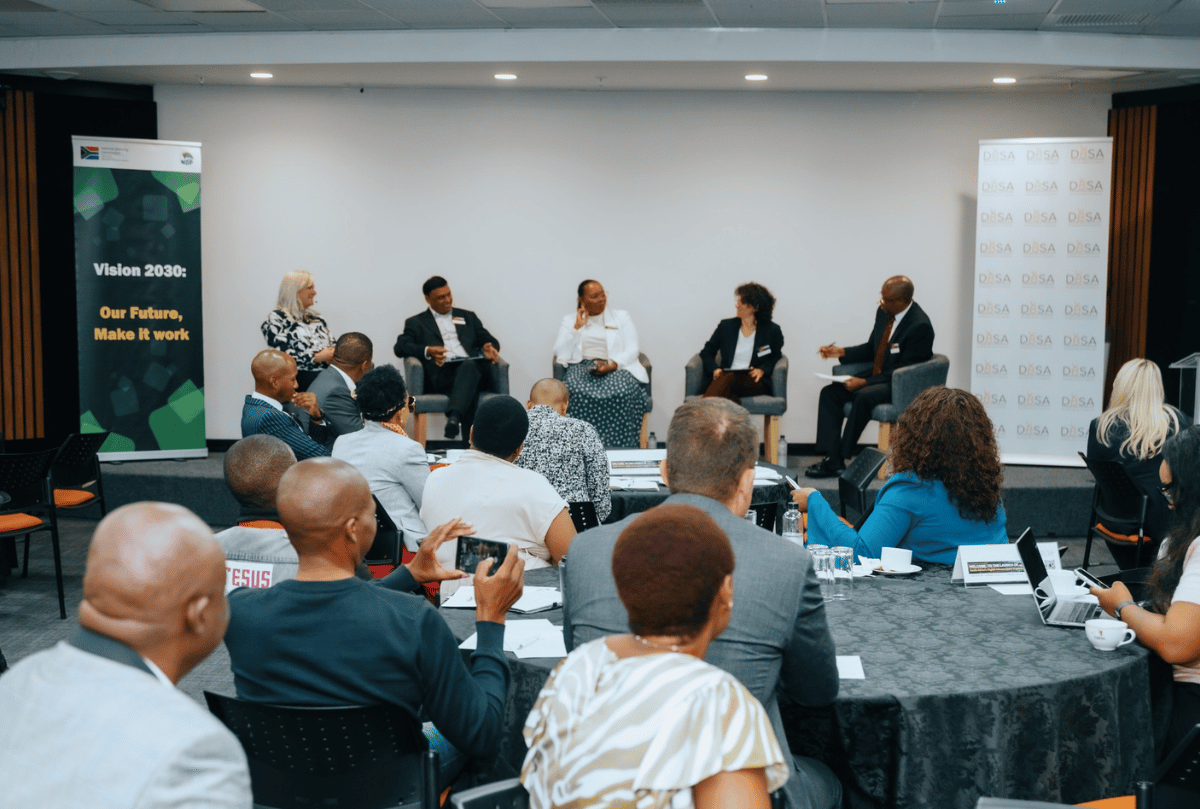
The Development Bank of Southern Africa , in partnership with the National Planning Commission, convened a high-level panel discussion at the DBSA Campus aimed at advancing South Africa’s digital infrastructure agenda and strengthening progress toward universal connectivity.
The session was moderated by Zeph Nhleko and brought together key stakeholders from government and industry, including Tanya Cohen, Nonkqubela Jordan-Dyani, Dr Sunil Piyarlall, and Juanita Clark. Discussions focused on the shift from simply expanding network coverage to ensuring meaningful access and active participation in the digital economy.
Central to the dialogue was a 2025 study commissioned by the Development Bank of Southern Africa and the National Planning Commission, which outlines the investment requirements and policy reforms needed for South Africa to achieve Universal and Meaningful Connectivity (UMC) by 2030 and 2035.
The study notes that while South Africa has achieved near-universal mobile coverage, with 4G reaching approximately 99.07% and 5G at 46.64%, access to fixed high-speed broadband remains limited, particularly in rural and peri-urban areas. Despite strong network availability, only 17.4% of households currently have internet access at home, highlighting a persistent digital divide.
It further shows that South Africa ranks 54th out of 67 countries in the 2024 World Digital Competitiveness Index, reflecting gradual improvement but continued challenges in fully leveraging digital transformation for economic growth.
To achieve nationwide broadband speeds of at least 100 Mbps by 2035, the report estimates significant investment needs. A least-cost, mobile-led approach would require about R140 billion, while fibre-intensive scenarios incorporating fixed wireless access and fibre-to-the-home infrastructure could push total requirements beyond R200 billion.
The study recommends a hybrid infrastructure model combining fibre backbones, 5G and fixed wireless networks, and satellite solutions for remote areas, emphasizing that no single technology will be sufficient to close the connectivity gap.
It also identifies several structural barriers, including affordability challenges driven by income inequality, infrastructure vandalism and theft, energy instability requiring backup systems, a shortage of digital and cloud engineering skills, and fragmented coordination across government institutions.
To address these issues, the study proposes key interventions such as a Universal and Meaningful Connectivity framework, a Digital Infrastructure One-Stop Shop to streamline approvals, a free basic data allowance for low-income households linked to social grants, and a “Dig Once” policy to encourage infrastructure sharing.
Panellists at the event emphasized the need for stronger coordination, regulatory efficiency, and improved infrastructure deployment processes to accelerate progress. They also highlighted ongoing challenges such as approval delays, duplication of infrastructure, and affordability constraints affecting rollout speed and access.
The discussion concluded that the next phase of South Africa’s digital transformation will depend heavily on effective execution, cross-sector collaboration, and coordinated delivery at scale.
