

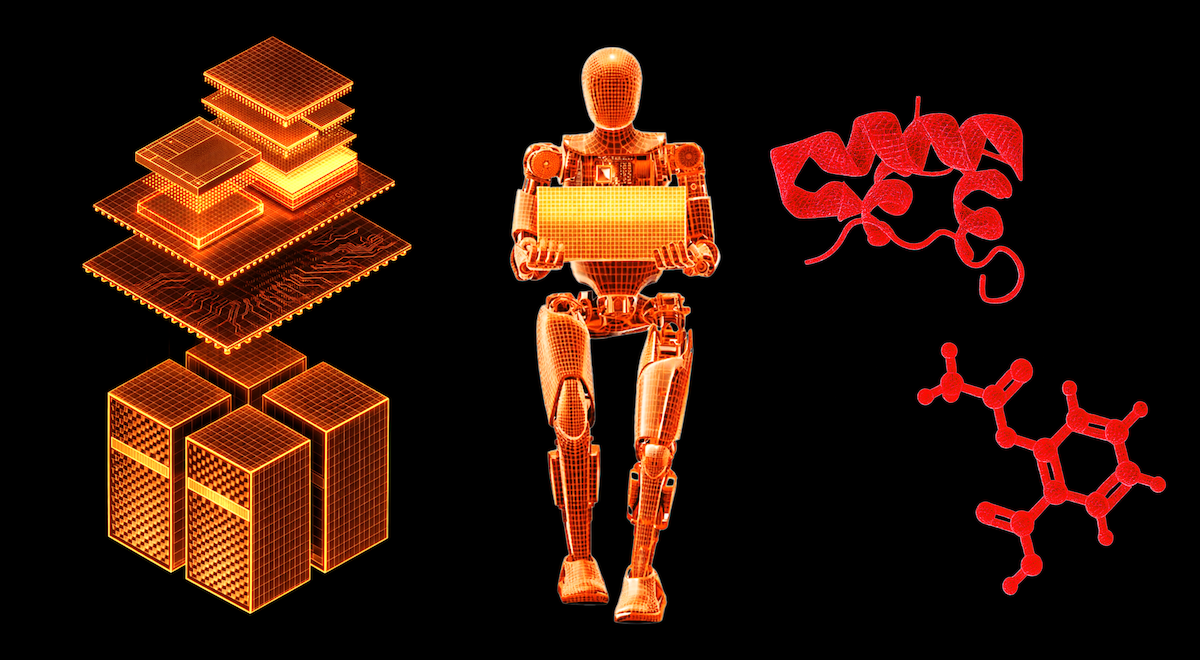
Cadence Maps Its Future Beyond EDA With Agentic AI and Simulation
At Cadence’s annual user conference in Santa Clara this week, anticipation in the room was palpable as Nvidia CEO Jensen Huang joined Cadence CEO Anirudh Devgan on stage to open the event for the gathered attendees. Before their fireside chat began, the two paused to sign a compute rack together in a brief, almost ceremonial moment that spoke to the depth of the companies’ partnership.
That relationship has its roots in semiconductor design, where Cadence’s EDA tools have supported Nvidia’s chip development and have steadily expanded into areas like simulation, systems design, and now AI-driven workflows.
During the discussion, Huang noted how the past two years of AI development have been a progression from generative models to systems that can reason and act, and that transition is redefining how engineering work gets done.

Cadence CEO Anirudh Devgan and Nvidia CEO Jensen Huang discuss the companies’ expanded partnership at CadenceLIVE
“We’re now at a point where agents are able to foresee reason and execute plans,” Huang said. “AI went from knowing everything, being able to spew out all kinds of knowledge and information, to now being able to use tools.”
Huang said Nvidia has seen a surge in its own internal agent use, with systems that reason through problems and then rely on established tools to carry out the work. Chip design is a key example, he said, noting that as agents take on roles in verification, analog design, and back-end workflows, demand for Cadence’s EDA tools is likely to increase substantially.
Huang’s comments push back on the narrative that AI could replace traditional engineering software. In domains like chip design, Huang described how the underlying algorithms are tightly validated and deeply embedded in production workflows. Instead of replacing them, these systems are now being built to call into those tools, ensuring that outputs remain verifiable and aligned with established design flows.
Huang also discussed how companies have historically been constrained by the number of available ASIC designers, noting that agentic systems could expand that capacity by allowing engineers to orchestrate many specialized agents at once.

Huang signs a compute cabinet at CadenceLIVE
The partnership announcement reinforced the fireside conversation, with Cadence outlining an expanded collaboration with Nvidia that will span agentic AI, physics-based simulation, and digital twins for semiconductor design, physical AI systems, and AI factories. Cadence said the collaboration will combine its design software and simulation portfolio with Nvidia’s accelerated computing, CUDA-X, Omniverse, and AI physics technologies.
Huang described physical AI as the next frontier for both companies, arguing that the industry is now entering a new phase beyond language models.
“Just as we had the ChatGPT moment, the generative AI moment for language, we’ve arrived at the generative AI moment for robotics. It’s called VLA: vision language action model, which is basically perception in, action out,” he said.
Huang said the combination of perception, reasoning, and action allows machines to handle unfamiliar scenarios by breaking them into simpler steps, much like humans do. Paired with rapid advances in robotics hardware, he said, that approach is enabling more general-purpose systems that can operate across a range of physical environments.
That line of thinking carried into Devgan’s keynote that followed, where he focused on how Cadence is readying its platform for this next phase of AI-driven engineering.
Cadence’s Roadmap: AgentStack and an Expansion Beyond Chip Design
As Devgan delved into Cadence’s latest product roadmap, he mentioned how he still sees EDA and IP as the company’s core business but now views that business through a wider lens that extends from chip design into full-stack engineering platforms and automation.
An important part of the roadmap is AgentStack, an orchestration environment Cadence unveiled as a way to connect its emerging “super agents” across the design flow. ChipStack, launched earlier this year for RTL design and verification, marked the first step in Cadence’s move toward agent-driven design workflows.

Devgan’s keynote included the company’s product roadmap
AgentStack builds on ChipStack by extending its “mental model” and multi-agent approach beyond RTL and verification into later stages of the design process, including physical and analog design. It is designed to coordinate long-running tasks across multiple agents while connecting directly into Cadence’s underlying EDA platforms running on Nvidia infrastructure.
In his keynote, Devgan said the company is extending that approach into analog design and back-end implementation, with each super agent able to call into more specialized sub-agents tied to existing Cadence tools. Rather than presenting those systems as standalone AI assistants, Devgan described them as a new automation layer built on top of Cadence’s underlying engines. In the Q&A session that followed, he said that Cadence’s advantages are its domain-specific “mental model” of chip design and its deeper access to tool APIs and software internals, which allow the company to orchestrate workflows at a more granular level than general-purpose model providers or customer-built agents.
From there, Devgan described what he sees as three phases of AI adoption: infrastructure AI, physical AI, and AI for science. While the first phase is still scaling, he said the next wave will center on systems that interact with the physical world, including robots and autonomous vehicles. AI for science, including areas like drug discovery and materials research, is already underway but remains earlier in its development, Devgan said. This AI adoption progression is actively shaping Cadence’s roadmap, driving its investments in simulation, digital twins, and tools designed to model and optimize everything from AI data centers to real-world systems. Overall, Cadence’s main strategy is to apply its core strengths in engineering software to a much wider set of use cases.
Inside Cadence’s Layered Approach to Agentic AI
If Devgan’s keynote laid out the roadmap, Paul Cunningham, Cadence’s senior vice president and general manager of the system verification group, offered a more detailed picture of how the company believes AI will change engineering work inside the design flow.
In his afternoon keynote, Cunningham said that the opportunity goes beyond adding chat interfaces to existing software. To illustrate, he described three distinct layers of AI inside Cadence’s strategy: optimization AI embedded directly in core engines, tool agents that simplify how engineers interact with existing software, and as Devgan mentioned, “super agents” designed to carry out end-to-end tasks across the design process.
Cunningham tied that approach back to two ideas he said have shaped Cadence for decades: abstraction and reuse. In the past, he said, Cadence helped raise the level of abstraction in chip design by moving engineers away from hand-crafted layouts toward high-level design languages. With AI, the company now sees a chance to raise that abstraction again, allowing systems to begin projects with human design documents like specifications, block diagrams, and architecture descriptions and translate them into working designs.

Cadence SVP and GM Paul Cunningham delivered a detailed keynote about the company’s agentic AI
Reuse takes on a new meaning as well, Cunningham noted. Where traditional EDA has often reused design hierarchies and repeated structures, AI creates the possibility of reusing tasks. Instead of forcing engineers to repeat the same sequences of analysis, scripting, debugging, and iteration, he said, agents can begin to capture and replay that work in a more automated way.
That logic has shaped Cadence’s layered AI strategy. Cunningham said optimization AI, like reinforcement learning systems embedded in Cadence products like Cerebrus and Verisium, are one avenue for accelerating physical design and verification. He described tool agents as another, as they make existing environments faster to use by turning common interactions into conversational and context-aware workflows. Super agents, he said, represent the next step: systems that combine LLMs, domain-specific knowledge graphs, and structured workflows to carry out more complex design tasks with greater consistency.
“We can already see that the complexity of a super agent is absolutely trending towards being as complex as some of our most advanced EDA tools. A super agent is, in and of itself, a piece of computational software,” Cunningham said.

Cadence’s layered approach (Graphic Courtesy of Cadence)
Cunningham said that complexity comes from the amount of information required to carry out real design tasks. Unlike simpler coding use cases, he noted, chip design involves millions of tokens of structured data, far beyond what a single model prompt can handle. To address that, Cadence is building agents that construct intermediate “knowledge graphs” of a design, capturing its structure, hierarchy, and intent before passing tasks to AI models.
He also examined another challenge: consistency. Because LLMs are probabilistic, he said, producing repeatable, production-ready results requires additional layers of control. Cadence’s approach relies on what he described as “skills” and structured workflows to guide models step-by-step through complex tasks, ensuring that outputs remain predictable and verifiable. That level of orchestration, Cunningham said, is what distinguishes super agents from general-purpose AI tools.
The Takeaway
The overall message of CadenceLIVE is that the company is now much more than an EDA software company, and these three keynotes showed attendees what that transition looks like. Huang reminded us that AI is moving from models that simply generate information to agentic systems that can act through tools. Devgan showed how Cadence is supporting that progression by extending its software stack across more of the design process and into other areas like physical AI. Cunningham described how that transition is being put into practice through the company’s layered agentic AI embedded directly into its tools and workflows. In short, EDA software isn’t going away anytime soon. If anything, it is becoming the foundation these new AI systems are being built around.
Related
Agentic AI, AI infrastructure, Anirudh Devgan, Cadence, CadenceLIVE, chip design, EDA, electronic design automation, Jensen Huang, NVIDIA, Paul Cunningham, physical AI, semiconductor industry


Yann LeCun’s AMI Secures $1B Seed to Develop AI World Models
Turing Award–winning AI researcher Yann LeCun has spent years arguing that large language models, at…

Deloitte’s State of AI 2026: Why Enterprise Execution Is Falling Behind Adoption
Deloitte’s latest State of the AI report shows that AI adoption continues to accelerate rapidly,…

SambaNova Eyes 10-Trillion Parameter Models for Agentic AI with New Chip
SambaNova has unveiled its latest chip, the SN50, which it says is five times faster…

Lilly Launches LillyPod NVIDIA DGX SuperPOD for Genomics and Drug Discovery AI
Built with over 1,000 NVIDIA Blackwell Ultra GPUs, LillyPod is now online to power scientific…

OpenAI Shutters Sora, Shifts Business Strategy Ahead of IPO
Back in 2022, OpenAI set off a chain reaction in the tech world when it…
Gartner Forecasts 90% Drop in LLM Inference Costs by 2030
STAMFORD, Conn., March 25, 2026 — By 2030, performing inference on a large language model (LLM)…

Cadence Maps Its Future Beyond EDA With Agentic AI and Simulation
At Cadence’s annual user conference in Santa Clara this week, anticipation in the room was…

LLNL Combines Machine Learning and 3D Printing for Shockwave Control Experiments
April 16, 2026 — Picture two materials sandwiched together. The boundary between them may appear flat,…
Canada Opens Applications for AI Supercomputing Infrastructure Program
OTTAWA, Ontario, April 16, 2026 — Canada is launching a national effort to build one of…
AMD and French Government Announce Plans to Advance AI Innovation, Research and Open Ecosystem Development
PARIS, April 16, 2026 – Today, AMD and representatives of the French government announced plans…
UC San Diego: New AI Approach Reveals Ocean Currents in Unprecedented Detail
April 15, 2026 — Scientists have developed a new method to measure ocean surface currents over…
Forrester’s Top 10 Emerging Technologies for 2026: AI Is No Longer Confined to Digital Workflows
CAMBRIDGE, Mass., April 15, 2026 — Forrester today released its The Top 10 Emerging Technologies…
