

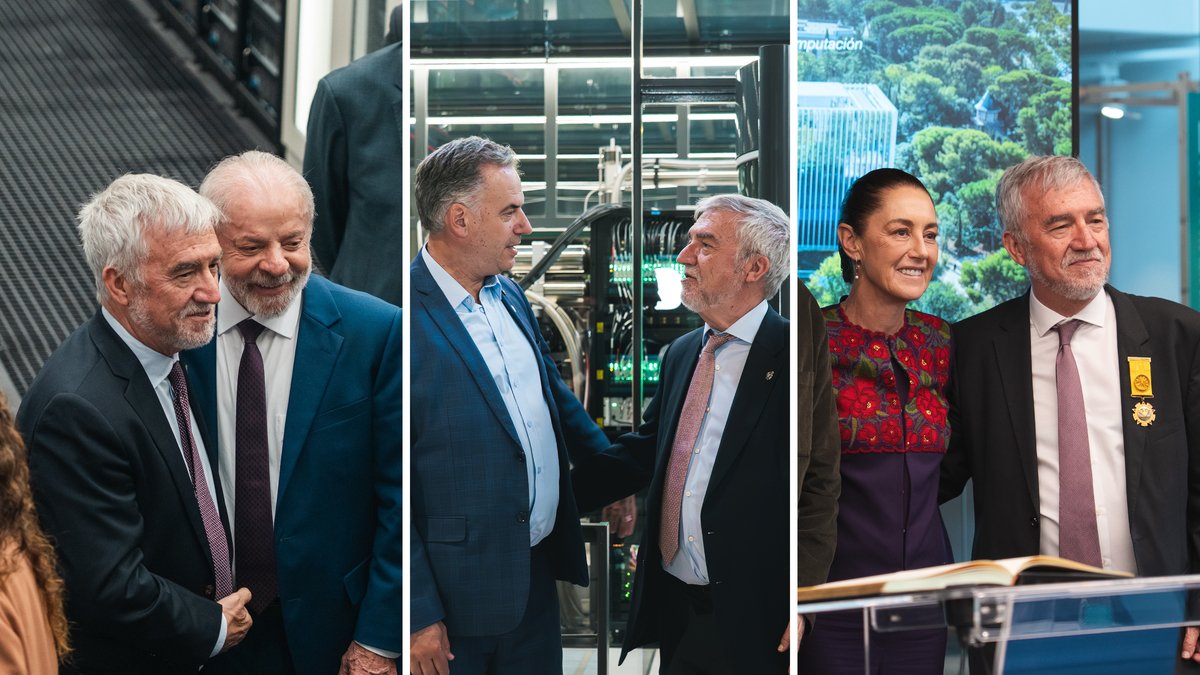
BSC Meeting with Latin American Presidents Focuses on AI, Digital Sovereignty
April 21, 2026 — The Barcelona Supercomputing Center – Centro Nacional de Supercomputación (BSC-CNS) hosted this weekend the presidents of Brazil, Luiz Inácio Lula da Silva; Uruguay, Yamandú Orsi; and Mexico, Claudia Sheinbaum, with the aim of consolidating and exploring new collaborations between the center and Latin American institutions to position the region in the development of artificial intelligence, a technology that will shape competitiveness and innovation in the coming years.
The visits of Luiz Inácio Lula da Silva, Yamandú Orsi and Claudia Sheinbaum reinforce a long trajectory of scientific collaboration and project new strategic axes in AI and technological sovereignty for the region.
This strategic alliance seeks to transform existing capabilities into a shared capacity of greater scale and impact that allows Latin America to face the global challenges of the digital era with technological sovereignty, ensuring that supercomputing and AI translate into tangible solutions for society.
During successive visits, Lula, Orsi and Sheinbaum met with Mateo Valero, director of BSC, and visited the MareNostrum 5 supercomputer and the MareNostrum Ona quantum partition, located in the emblematic Torre Girona chapel, adjacent to the BSC headquarters.
The meetings were also attended by the associate director, Cristian Cantón, the Director of Operations, Sergi Girona, and BSC directors and researchers specialized in strategic areas such as AI, chip design, health, climate change, emergency response and energy management, as well as scientists from the respective countries who are part of the 35% of foreign staff in the center’s workforce, which is composed of more than 1,400 employees.
Among the recent milestones of collaboration between the BSC and Latin America are the RISC and RISC2 projects, led by BSC, to coordinate HPC research between Europe and Latin America. Currently, this network is evolving into the EU-LAC supercomputing network for AI, a project coordinated by the BSC AI Institute aimed at accelerating digital transformation and the development of joint use cases in AI, agriculture and climate change.
Complementing these initiatives, the FiatLatam project will start in June 2026 to promote the collaborative development of language models (LLM) that reflect the rich linguistic diversity, contexts and sectors of Latin American reality.
Within this ecosystem, Mexico stands out as the country with the longest trajectory of collaboration, initiated in 1988 —long before the founding of the center— with agreements that have made it possible to train more than 1,000 PhDs.
A fundamental pillar is the relationship with the Instituto Politécnico Nacional (IPN), which since 1995 has collaborated in the creation of the Centro de Investigación en Computación (CIC) and in the development of the Lagarto processor, the first open-source chip, based on RISC-V technology.
The collaboration between BSC and Mexico has also resulted in applied technological solutions, such as the air quality forecasting system for Mexico City, based on the BSC’s Calíope model; the ENERXICO project, which has generated advanced simulations for the oil, gas and renewable energy sectors; and the first European urgent computing test during the Simulacro Nacional de Sismo de México, using MareNostrum 5 to generate real-time intensity maps.
This joint effort serves as the basis for the future construction of the Mexican national supercomputer, Coatlicue, through an agreement with the Secretaría de Ciencia, Humanidades, Tecnología e Innovación (SECIHTI) of the Mexican government with the aim of promoting AI development in the country.
For his part, Brazilian president Luiz Inácio Lula da Silva highlighted that, to guarantee digital sovereignty, Brazil and Spain are promoting cooperation between BSC and the Laboratório Nacional de Computação Científica (LNCC) for the development of joint AI projects.
At the reception of the Mexican delegation, led by President Sheinbaum, the Catalan artist Joan Manuel Serrat also took part, who maintains a close connection with Mexico, a country where he went into exile in 1975.
Source: BSC-CNS
Related


Yann LeCun’s AMI Secures $1B Seed to Develop AI World Models
Turing Award–winning AI researcher Yann LeCun has spent years arguing that large language models, at…

Deloitte’s State of AI 2026: Why Enterprise Execution Is Falling Behind Adoption
Deloitte’s latest State of the AI report shows that AI adoption continues to accelerate rapidly,…

SambaNova Eyes 10-Trillion Parameter Models for Agentic AI with New Chip
SambaNova has unveiled its latest chip, the SN50, which it says is five times faster…

OpenAI Shutters Sora, Shifts Business Strategy Ahead of IPO
Back in 2022, OpenAI set off a chain reaction in the tech world when it…

Gartner Forecasts 90% Drop in LLM Inference Costs by 2030
STAMFORD, Conn., March 25, 2026 — By 2030, performing inference on a large language model (LLM)…
Anthropic Unveils ‘Project Glasswing’ as Claude Mythos Targets Software Vulnerabilities
April 9, 2026 — Anthropic has announced Project Glasswing, a new initiative that brings together Amazon…

BSC Meeting with Latin American Presidents Focuses on AI, Digital Sovereignty
April 21, 2026 — The Barcelona Supercomputing Center – Centro Nacional de Supercomputación (BSC-CNS) hosted…
Boehringer Ingelheim Adds London AI Center to Global Computational Innovation Network
INGELHEIM, Germany, and LONDON, April 20, 2026 — Boehringer Ingelheim today announced the expansion of its…
UK Launches £500M Sovereign AI Unit to Back Domestic Startups and Infrastructure
April 20, 2026 — British AI startups working in fields that could transform everyone’s lives for…

BCG Finds AI Will Transform Over Half of Jobs Within Three Years
One consistent viewpoint in debates over AI’s impact on employment has been that the technology…

Training Isn’t Enough: Reasoning Models and LLMs Need Reinforcement Learning
Most people familiar with generative models know that LLMs are trained on the entirety of…
UCSD: AI-Enhanced Microscopy Produces Crisp, Real-time Video Inside Live Cells
April 20, 2026 — Using artificial intelligence, engineers at the University of California San Diego…
