

LLNL’s ‘STEM with Phones’ Program Brings AI-Powered Physics Research to Students
May 14, 2026 — Forget spreadsheets. At Lawrence Livermore National Laboratory’s (LLNL) STEM with Phones student workshop, students are using smartphones and artificial intelligence (AI) to conduct advanced scientific analysis.
Led by LLNL’s David Rakestraw, participants in the program discover how to turn a tool already in their pocket — a smartphone — into an instrument for investigating fundamental physics principles. The devices are equipped with advanced sensors and remarkable computational capabilities. Throughout the week-long program, students learn how to use their devices to conduct hands-on measurements and apply AI to explore real-world phenomena.
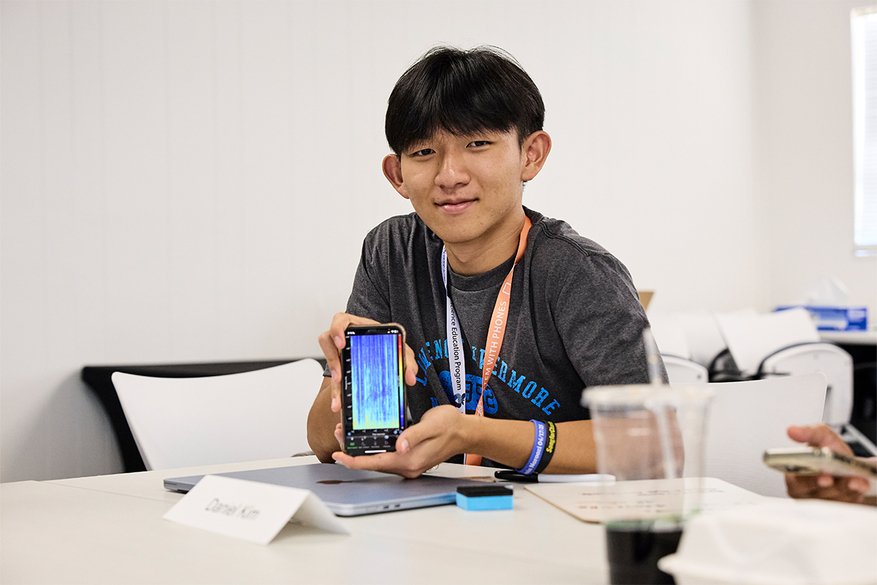
At LLNL’s STEM with Phones summer workshop, Daniel Kim participated in a demonstration on how a smartphone can be used for scientific research and data analysis. Photo credit: Garry McLeod.
“I saw students being very excited about trying to solve a problem and recognizing how these new intelligent tools could work side-by-side with them to turn them not into just consumers of knowledge, but real creators,” said Rakestraw.
The summer program inspired one high school participant from Acalanes High School in Lafayette, California, Daniel Kim, to launch an innovative research project: combining observational astronomy with custom-analysis software to measure Earth’s rate of rotation.
Kim and a fellow student from his high school, Tsimur Havarko, turned a smartphone up toward the night sky and captured 945 photographs that they blended into a single image using a custom application they developed with AI. The resulting image maps the apparent motion of the stars as they move across frame as a result of the Earth’s rotation. Measuring those long arcs by hand would have been time-consuming, so Kim and Havarko created another custom code to measure the length of the arc and the distance from the north star and then calculate Earth’s angular velocity.
“That particular software was about 1000 lines of code and would have taken software engineers several weeks to write it,” said Rakestraw. “This illustrates how high school students with no coding experience are able to create sophisticated analysis tools, which completely changes the kinds of problems they’re able to investigate.”
As a mentor, Rakestraw collaborated with the students on evaluating the output and determining the validity of the analysis with fundamental physics principles. He emphasized that this still was a hard problem to solve, but AI dramatically expanded what was possible within the time frame and experience constraints of a student-led research project.
The Physics Teacher, a peer-reviewed journal, published the study as an example to highlight the emerging framework for cognitive-activated learning with AI augmentation.
For Rakestraw, the project’s success offered a proof of principle for the new approach to science education in the age of AI. Educators can help students accomplish incredible research by teaching students to use these tools effectively.
Physics with Phones is evolving to embrace this framework throughout the summer program.
“Two years ago, it was just all smartphone sensors and then using spreadsheets to do the analysis. Last year, I started to integrate AI, and this year AI will be an instrumental component of the student investigations and there will be hardly any analysis to do with spreadsheets anymore,” said Rakestraw.
As AI tools continue to evolve, the Physics with Phones program offers an exciting approach to ensure science education evolves with them. Students can use these emerging technologies to think critically, analyze complex data and purse more advanced scientific questions.
Source: LLNL
Related


Yann LeCun’s AMI Secures $1B Seed to Develop AI World Models
Turing Award–winning AI researcher Yann LeCun has spent years arguing that large language models, at…

Deloitte’s State of AI 2026: Why Enterprise Execution Is Falling Behind Adoption
Deloitte’s latest State of the AI report shows that AI adoption continues to accelerate rapidly,…

Anthropic Unveils ‘Project Glasswing’ as Claude Mythos Targets Software Vulnerabilities
April 9, 2026 — Anthropic has announced Project Glasswing, a new initiative that brings together Amazon…

OpenAI Shutters Sora, Shifts Business Strategy Ahead of IPO
Back in 2022, OpenAI set off a chain reaction in the tech world when it…

Google Unveils Gemini Enterprise Agent Platform, Expands Vertex AI into Full Agent Stack
At Google Cloud Next 2026 in Las Vegas this week, the company announced major changes…
Gartner Forecasts 90% Drop in LLM Inference Costs by 2030
STAMFORD, Conn., March 25, 2026 — By 2030, performing inference on a large language model (LLM)…

FAU and P&G Host dAIper Hackathon Focused on AI and Computer Vision
May 15, 2026 — The dAIper Hackathon, held from April 24 to 26, 2026, was a…
Accenture Federal Services Expands OpenAI Collaboration for Federal AI Adoption
ARLINGTON, Va., May 14, 2026 — Accenture Federal Services and OpenAI today announced a strategic collaboration…
Argonne Researchers Advance New Tech Through Re-Envisioned SciDAC Institutes
Researchers will develop advanced tools to address complex problems on leadership-class computing systems and assist…
LLNL’s ‘STEM with Phones’ Program Brings AI-Powered Physics Research to Students
May 14, 2026 — Forget spreadsheets. At Lawrence Livermore National Laboratory’s (LLNL) STEM with Phones student workshop,…
Graphon AI Emerges from Stealth with $8.3M to Build ‘Pre-Model’ Intelligence Layer for Enterprise AI
SAN FRANCISCO, May 14, 2026 — Graphon AI emerged from stealth today with $8.3 million in…
Equinix Puts Enterprises in Control of Data Sovereignty Across Hybrid Multicloud Environments
REDWOOD CITY, Calif., May 14, 2026 — Equinix, Inc. today announced the global expansion of…
