

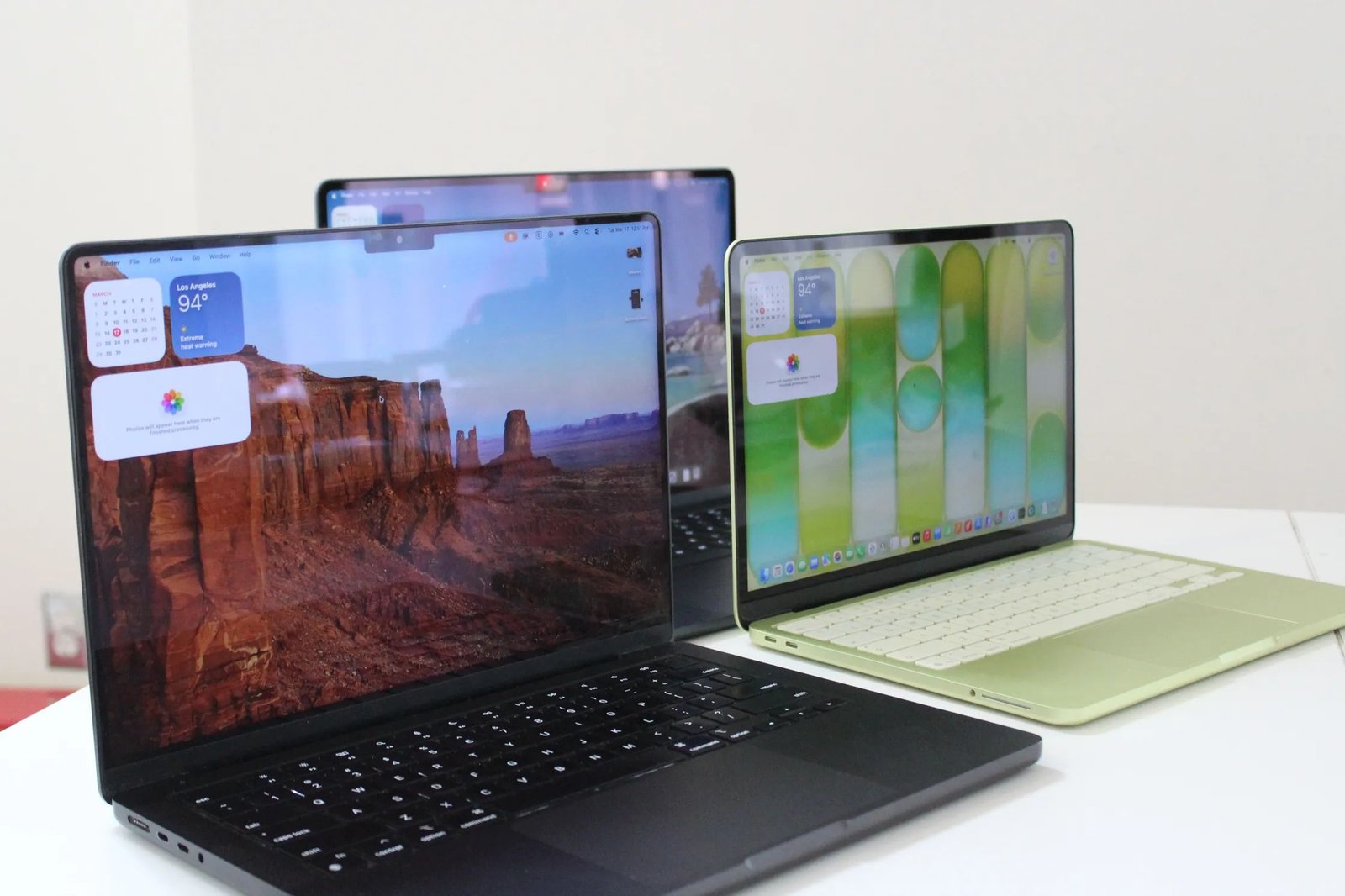
The meeting ends at 6. Your MacBook died at 4.
Picture it. You’re in the third city this week, back-to-back calls, a deck to finish before dinner, and somewhere between the airport lounge and the hotel lobby, your laptop gave up before you did. You had the faster machine. The more expensive one. The one with the chip that benchmarks reviewers drool over. None of that mattered when the battery icon turned red at 38,000 feet with two hours still on the clock.
This is not a fringe scenario. For most business buyers, this is Tuesday.
The MacBook decision has been framed as a performance debate for years. It shouldn’t be. For the overwhelming majority of business users, the only spec that determines whether your laptop actually works for you is the one Apple lists last and buyers ignore first: battery life.
The Trade-Off, Honestly Explained
Here is what the spec sheet won’t tell you.
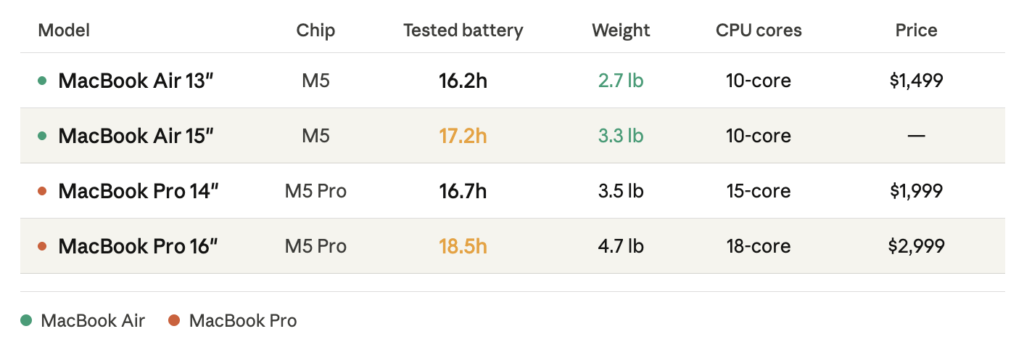
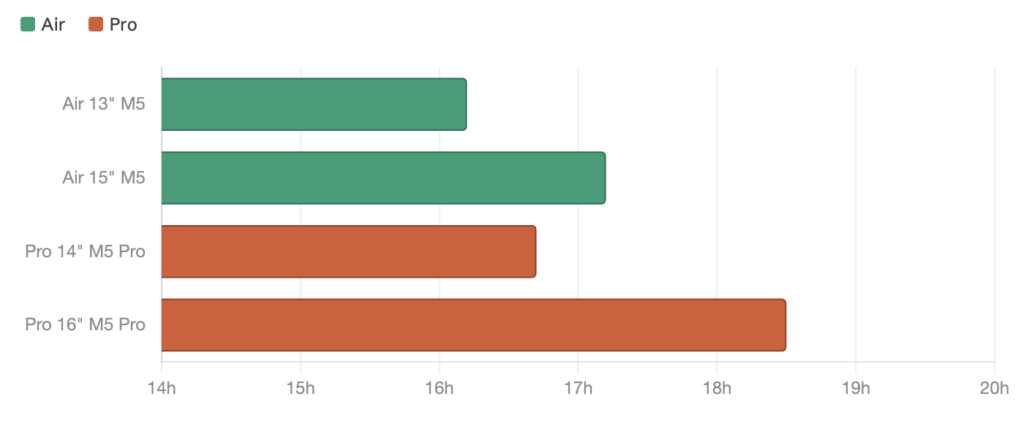
The MacBook Air M5 lasts roughly 16 hours in real-world use. The MacBook Pro 16-inch M5 Pro lasts roughly 18 and a half. On paper, the Pro wins on both battery and performance. In practice, you are paying nearly double the net cost over three years for two extra hours of endurance and a chip that most business workloads will never fully wake up.
The Air weighs 2.7 pounds. The 16-inch Pro weighs 4.7. That two-pound difference feels abstract until you’re hauling both through an airport at 6AM.
The performance gap is real but surgical. The Pro’s M5 chip with 18 cores outpaces the Air’s 10-core M5 by roughly 20 percent in multi-core benchmarks. That sounds significant. It is, for the right workload. For email, Slack, browser tabs, Zoom calls, and a PowerPoint that’s been open since Monday, the Air doesn’t break a sweat. It doesn’t even spin a fan. It doesn’t have one.
That fanless design is the Air’s most misunderstood feature. Without active cooling, the Air throttles under sustained heavy load after roughly 30 minutes. That’s the actual trade-off. Not battery. Not weight. Not even price. It’s this: the Air was built for how most people work, and the Pro was built for the ones who push machines to their limit for hours at a time.
Most business buyers are not those people.
When Battery Wins: The Case for the MacBook Air
If your workday looks anything like this – meetings, documents, email, occasional video, a browser with too many tabs, the MacBook Air M5 is the better business laptop. Full stop.
Tested in real conditions, the 13-inch Air delivers around 16 hours of Wi-Fi use. The 15-inch edges past 17. That covers a full travel day, a red-eye flight, a conference, and the hotel room catch-up session without once hunting for a power brick. The Pro 16-inch beats it slightly on endurance but asks you to carry an extra two pounds to get there.
The Air handles every standard business workload without hesitation. Video calls, cloud apps, Office, light data work, presentations, remote desktop. None of these tasks come close to stressing an M5 chip. The performance ceiling of the Air is so far above typical business use that calling it a limitation is almost dishonest.
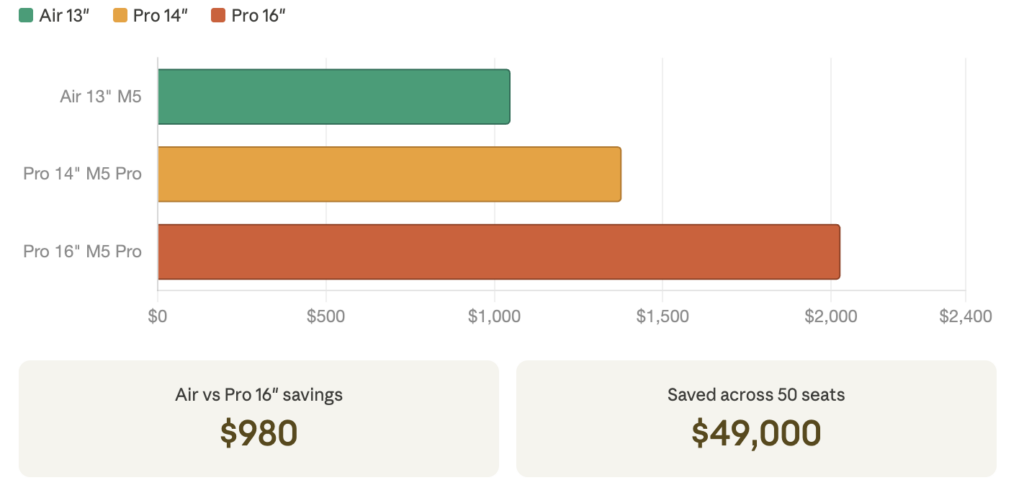
There is also the question of money. The 13-inch Air M5 runs around $1,500. After three years and resale, the net cost lands near $1,050. The Pro 16-inch with M5 Pro costs nearly twice that on the same math. For a fleet of 50 employees, that delta is not a rounding error.
The Air is not a compromise. It is a precision decision. For mobile professionals, executives, salespeople, consultants, and anyone whose heaviest task is a pivot table, the Air doesn’t just compete with the Pro. It wins.
When Performance Wins: The Case for the MacBook Pro
There is a category of business user for whom the Air genuinely falls short. If you are in that category, you already know it, because your machine slows down and you feel it every day.
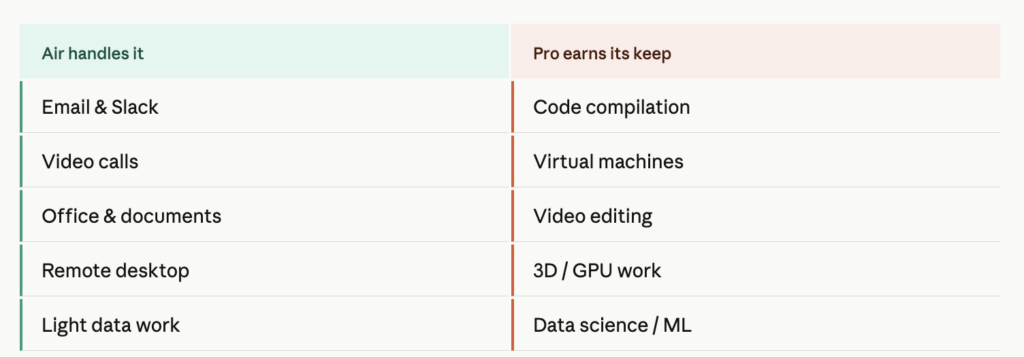
Developers compiling large codebases. Data scientists running models. Video editors cutting ProRes footage on deadline. Engineers running virtual machines. These are not edge cases in their world. They are the job. And the job demands sustained, unthrottled CPU power that the Air, without active cooling, cannot consistently deliver over long sessions.
This is where the Pro earns its name. The M5 Pro chip in the 14-inch model, with active cooling and up to 18 CPU cores, maintains peak performance through hours of heavy load without slowing down. The 16-inch goes further still, with 20 GPU cores, Thunderbolt 5 connectivity, and a 100Wh battery that still clocks 18 and a half hours in normal use.
For these users, performance is not a luxury. It is the direct input to their output. A faster compile saves 20 minutes a day. Faster renders save hours a week. The Pro’s premium pays for itself in recovered time, not specs.
The 14-inch Pro is the sharper pick for most in this group. It delivers the sustained performance of an actively cooled chip, battery life that rivals the Air in light use, and a form factor that doesn’t punish you for carrying it. The 16-inch is for the work that needs every core firing at once, and the professionals who know exactly why.
If your Mac breaks a sweat for a living, buy the Pro. If it doesn’t, you’re buying performance you’ll never use.
What People Get Wrong
The most common mistake business buyers make is conflating “powerful” with “better.” It’s an easy trap. The Pro sounds more serious. The specs read more impressive. It feels like the responsible choice for a professional tool.
It isn’t. Not for most roles.
The second mistake is treating battery life as the secondary spec. Buyers compare processors first and check battery numbers last, as if endurance is a nice-to-have. For anyone who works untethered, battery life is the spec that determines whether the laptop actually functions as a laptop or as a very expensive desk ornament near a wall socket.
The third mistake is buying for theoretical future workloads. “I might need it someday” is not a procurement strategy. Buy for the work you actually do, not the work you imagine doing in a more cinematic version of your job.
And finally, people underestimate the Air. Because it’s lighter, cheaper, and fanless, it reads as the lesser machine. In benchmark obsessed circles it is. In real business use, it outperforms the Pro where it matters most: from morning to night, without a charger.
The Verdict
The MacBook Air M5 is the right laptop for most business buyers. Not as a budget compromise. Not as a starter device. As the actual best fit for how the majority of business professionals work every day.
It lasts longer than most workdays. It weighs less than a hardcover book. It handles every standard business task without slowing down. And it costs significantly less over three years when you account for resale value.
The MacBook Pro earns its place for developers, analysts, editors, and anyone whose work genuinely stresses a chip for hours at a time. For that user, the extra cost, the extra weight, and the active cooling are not premiums. They are requirements.
For everyone else, the answer has been sitting in Apple’s lineup at 2.7 pounds the whole time.
Buy This, Not That
Choose the MacBook Air 13-inch M5 if you travel frequently, your work lives in a browser and Office suite, and you want the longest untethered battery at the lowest weight.
Choose the MacBook Air 15-inch M5 if you want the same endurance with a bigger screen and can handle the slight weight increase.
Choose the MacBook Pro 14-inch M5 Pro if you run VMs, compile code, or work in heavy creative applications and need sustained performance without the bulk of the 16-inch.
Choose the MacBook Pro 16-inch M5 Pro or Max if maximum CPU and GPU output is non-negotiable and the weight is something you’ve already made peace with.
