

Texas A&M to Build 1st National Self-Driving Lab for Metals, Open to Researchers Nationwide
Researchers have received a $24.9M grant to develop an NSF Materials Innovation Platform where universities, national laboratories and industry members can run alloy-discovery campaigns using robotic systems and artificial intelligence.
BRYAN-COLLEGE STATION, Texas, Aug. 5, 2026 — A six-year, $24.9 million grant from the U.S. National Science Foundation (NSF) will establish the Autonomous Robotic Metallurgist Materials Innovation Platform (ARM-MIP) at Texas A&M University — a national user facility where robots and artificial intelligence take on the repetitive labor of alloy discovery, freeing scientists to focus on discovery itself.
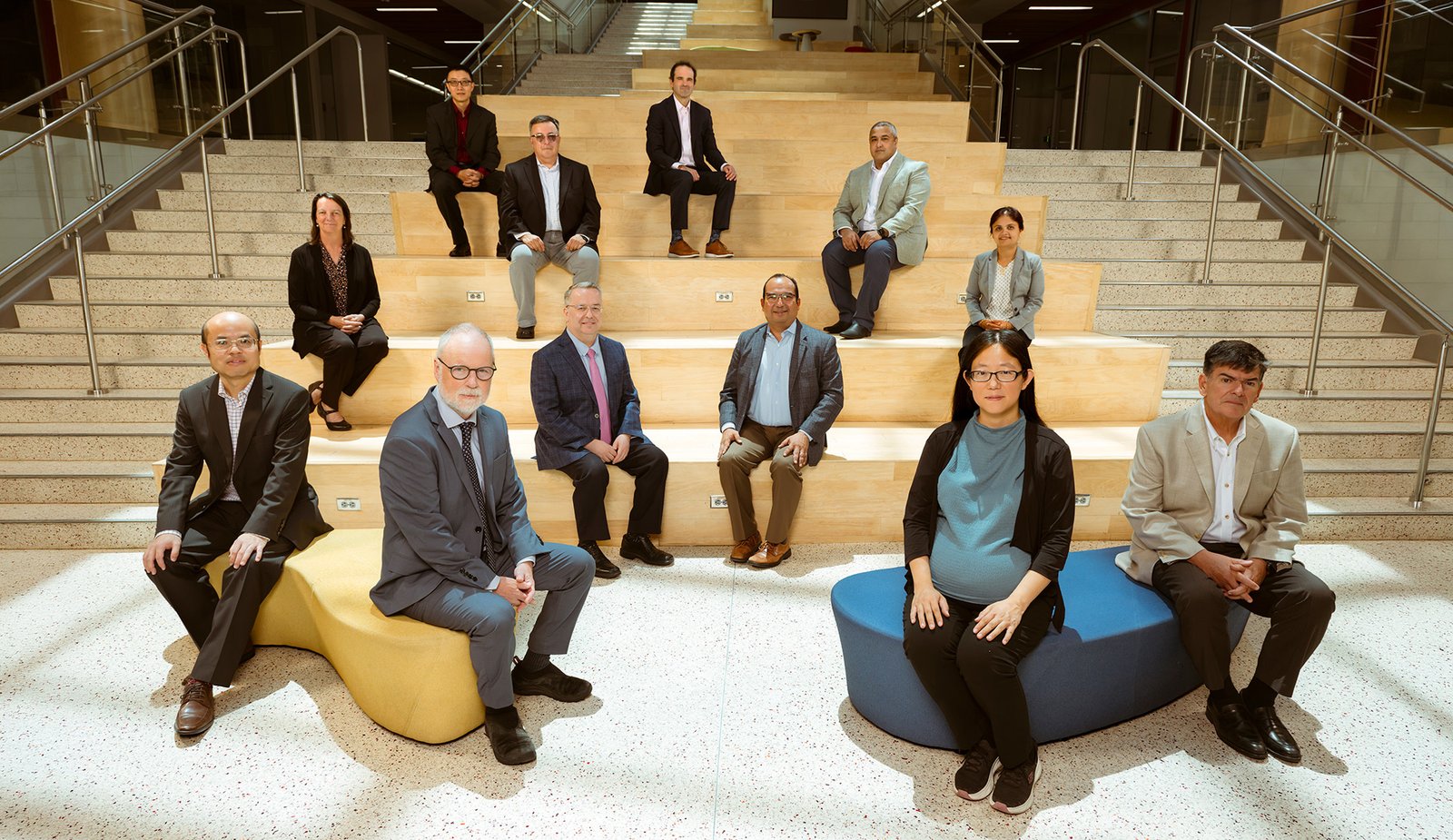
First Row (Left to Right): Dr. Shuiwang Ji, Dr. Nick Duffield, Dr. Minghui Zheng, Dr. Enrique Lavernia; Second Row (Left to Right): Dr. Ibrahim Karaman, Dr. Raymundo Arroyave; Third Row: (Left to Right): Dr. Julie M. Schoenung, Dr. Sharmila Pathikonda; Fourth Row: (Left to Right): Dr. Miladin Radovic, Dr. Bilal Mansoor; Fifth Row: (Left to Right): Dr. Jian Tao, Dr. Douglas Allaire
Credit: Leon Contreras/Texas A&M Engineering
ARM-MIP will be sited at The Texas A&M University System RELLIS Campus in Bryan, a dedicated research campus that also hosts the Texas A&M Engineering Experiment Station and the U.S. Army Transformation and Training Command’s central testing hub at the George H.W. Bush Combat Development Complex. The platform is designed to reach more than 200 users a year and 50 alloys per month in its first year, scaling to more than 200 alloys per month by year six.
“The establishment of ARM-MIP at Texas A&M reinforces our role as a national leader in the research addressing critical needs for the nation,” said Texas A&M President Dr. Susan Ballabina. “By opening this facility to researchers across the United States, we are expanding access to cutting-edge capabilities while accelerating discoveries that can strengthen industries, enhance national security and improve lives.”
“Housing the ARM-MIP facility at Texas A&M positions our students and faculty to collaborate with leading metal alloy researchers from across the nation,” said Dr. Robert H. Bishop, vice chancellor and dean of Texas A&M Engineering. “Minimizing repetitive labor and maximizing time spent creating new alloys and interpreting results allows us to have an impact at scale.”
The grant will be awarded through NSF’s Materials Innovation Platforms program, the agency’s national user-facility initiative for materials research. Only four platforms exist today — for two-dimensional crystals, interface materials, bio-derived polymers and glycomaterials. ARM-MIP will be the fifth, and the first devoted to metals.
“We are very grateful to NSF for providing us with the opportunity to build ARM-MIP, the first self-driving laboratory for metallurgy as a user facility,” said Dr. Raymundo Arróyave, Chevron Professor II in the Department of Materials Science and Engineering and director of ARM-MIP. “Through ARM-MIP, we seek to democratize access to state-of-the-art research facilities, accelerate how alloys are developed, and liberate our most valuable resource — human minds — so they dream of the new materials that transform our world.”
Per Arróyave, ARM-MIP does not belong solely to Texas A&M but to the country. Researchers from universities, U.S. companies and national laboratories will apply for time, come to Texas A&M, and run their own experiments alongside the facility’s staff and robots — then carry those methods home.
Researchers can also use the facility remotely, shipping samples or sending a scientific question and letting the platform help plan and execute the work. That remote option could benefit scientists at smaller colleges and in states that have historically received less federal research funding, who otherwise not have access to equipment of this kind.
“ARM-MIP embodies the kind of ambitious, interdisciplinary research enterprise we are building at Texas A&M,” said Dr. Angela Wilson, Texas A&M vice president for research. “It will be a national asset that will drive scientific advancement, strengthen U.S. competitiveness and create new opportunities for researchers and students alike.”
Access is free to U.S. academic users, and companies of any size can engage on commercial terms, with intellectual property terms settled before a project begins. Researchers plan that by year six, half of all equipment time will be committed to external users. The team also plans to build a consortium of industrial and national laboratory members around the facility, who help set research directions, share in the results, and sustain the facility beyond the initial award.
ARM-MIP’s founding industry partner, Multiscale Technologies, will provide its MIND 3.0 platform as the knowledge-sharing backbone of the facility, making ARM-MIP data, workflows and models accessible to the broader materials research community.
“We are building a time machine for metallurgy,” said Dr. Ibrahim Karaman, the co-director of ARM-MIP and head of the Department of Materials Science and Engineering. “Experiments that once required years of labor will now be completed in weeks. This will allow students and researchers to focus less on making samples and more on making discoveries. As importantly, it will train the next generation of engineers to work at the intersection of materials, automation and AI, where many of the new breakthroughs will occur.”
ARM-MIP’s robotic systems will melt, shape, heat-treat and test alloys around the clock. AI will analyze each result and choose what to make next — the way an experienced metallurgist would, but far faster and without delay. Simulations predict what is likely to happen before any metal is poured, so the robots spend their time on experiments worth running. The loop runs continuously and sharpens with every batch.
ARM-MIP’s central scientific bet sets it apart from other efforts to speed up materials discovery. Most vary only the recipe — which elements, and how much of each. ARM-MIP also controls how the metal is made — how hot it gets, how fast it cools, how it is worked. That processing history determines the metal’s internal structure, which decides whether a material is strong enough to survive inside a jet engine. Two pieces of metal with identical chemistry can behave nothing alike depending on how they were made, the same reason a blacksmith’s quench changes a blade.
As machines take on the repetitive tasks needed to test new alloys, researchers are freed to do what only humans can: ask the right question, recognize when a result is unique enough to matter, and decide what to do next.
The research team has already shown successful proof of concept through their BIRDSHOT program, which has showcased 100-fold acceleration of alloy discovery. They have designed, synthesized and characterized more than 1,150 alloys in four years — every one of them prepared by hand by graduate students and postdoctoral researchers. ARM-MIP will build on that proven methodology with around-the-clock robotic systems that remove the manual bottleneck.
Graduate student Mrinalini Mulukutla joined the BIRDSHOT program during the first year of her graduate studies and has since helped coordinate discovery campaigns.
“I have had the chance to help brainstorm ideas from set-up to building and deploying these frameworks for accelerated alloy development. We have demonstrated the strengths of AI-guided materials design but have also come across many bottlenecks in the overall process,” said Mulukutla. “We’ve built some really exciting AI-driven frameworks, but behind the scenes there’s still a lot of manual coordination, sample tracking, repetitive lab work, and data management.”
Mulukutla emphasizes that even with these AI tools, graduate students involved in each stage of alloy discovery and production still spend a significant amount of time on repetitive work to keep experiments and data collection flowing smoothly.
“What excites me about ARM-MIP is that it has the potential to change that,” she said. “By automating the routine work that machines can do, it will free students like me to spend more time imagining and designing newer materials that will enable future technologies, rather than managing the logistics of getting there.”
More than 300 researchers are expected to be trained by year six — in metallurgy and in the AI methods that guide the search, which users are taught to interpret rather than treat as a black box. Data, software and methods will be released publicly, including the failed experiments that are often the most instructive results in materials research, yet are rarely published.ARM-MIP brings together 15 faculty and staff whose combined expertise spans experimental and computational materials science, artificial intelligence, optimization, robotics, digital twinning and visualization; and graduate education and mentorship — including two members of the National Academy of Engineering.
Source: Alyssa Schaechinger, Texas A&M University College of Engineering
Related


NVIDIA Announces Financial Results for 1st Quarter Fiscal 2027
SANTA CLARA, Calif., May 21, 2026 — NVIDIA (NASDAQ: NVDA) has reported record revenue for…
OpenAI Launches Deployment Company to Scale Enterprise AI Adoption
OpenAI has agreed to acquire Tomoro, giving the OpenAI Deployment Company experienced Forward Deployed Engineers…
NVIDIA Launches Cosmos 3, the Open Frontier Foundation Model for Physical AI
TAIPEI, Taiwan, June 1, 2026 — NVIDIA today launched NVIDIA Cosmos 3, an open world…

SpaceX, OpenAI, and Anthropic IPOs: Can Wall Street Finance the AI Boom?
Elon Musk’s SpaceX has filed for what could become the largest IPO in history. It…
NVIDIA Partners with Software Leaders to Build Secure, Autonomous AI Agents
TAIPEI, Taiwan, June 1, 2026 — NVIDIA today announced new software, open source models and…
SK Telecom and NVIDIA Build AI Infrastructure to Power Korea’s AI Innovation
Korea’s Leading Telco to Add NVIDIA-Powered AI Cloud Capacity Built on NVIDIA DSX AI Factory…

Texas A&M to Build 1st National Self-Driving Lab for Metals, Open to Researchers Nationwide
Researchers have received a $24.9M grant to develop an NSF Materials Innovation Platform where universities,…
Linux Foundation Forms Tokenomics Foundation for AI Cost and Value Standards
SAN FRANCISCO, Aug. 5, 2026 — The Linux Foundation, the nonprofit organization enabling mass innovation…

Can AMD Lower CUDA’s Moat with ROCm.AI?
As part of its Advancing AI launch event two weeks ago, AMD unveiled ROCm.ai, a…
Red Hat Launches Open Source asago Project for AI Governance Automation
RALEIGH, N.C., Aug. 4, 2026 — Red Hat today announced the formation of asago, an open…
Zenity Raises $125M Series C to Expand AI Agent Security Platform
NEW YORK, Aug, 4, 2026 – Zenity has announced a $125 million Series C led…
Anaconda Acquires Enkrypt AI to Secure the Trillion-Token Enterprise
AUSTIN, Texas, Aug. 4, 2026 — Anaconda Inc. today announced it has acquired Enkrypt AI, an…
