

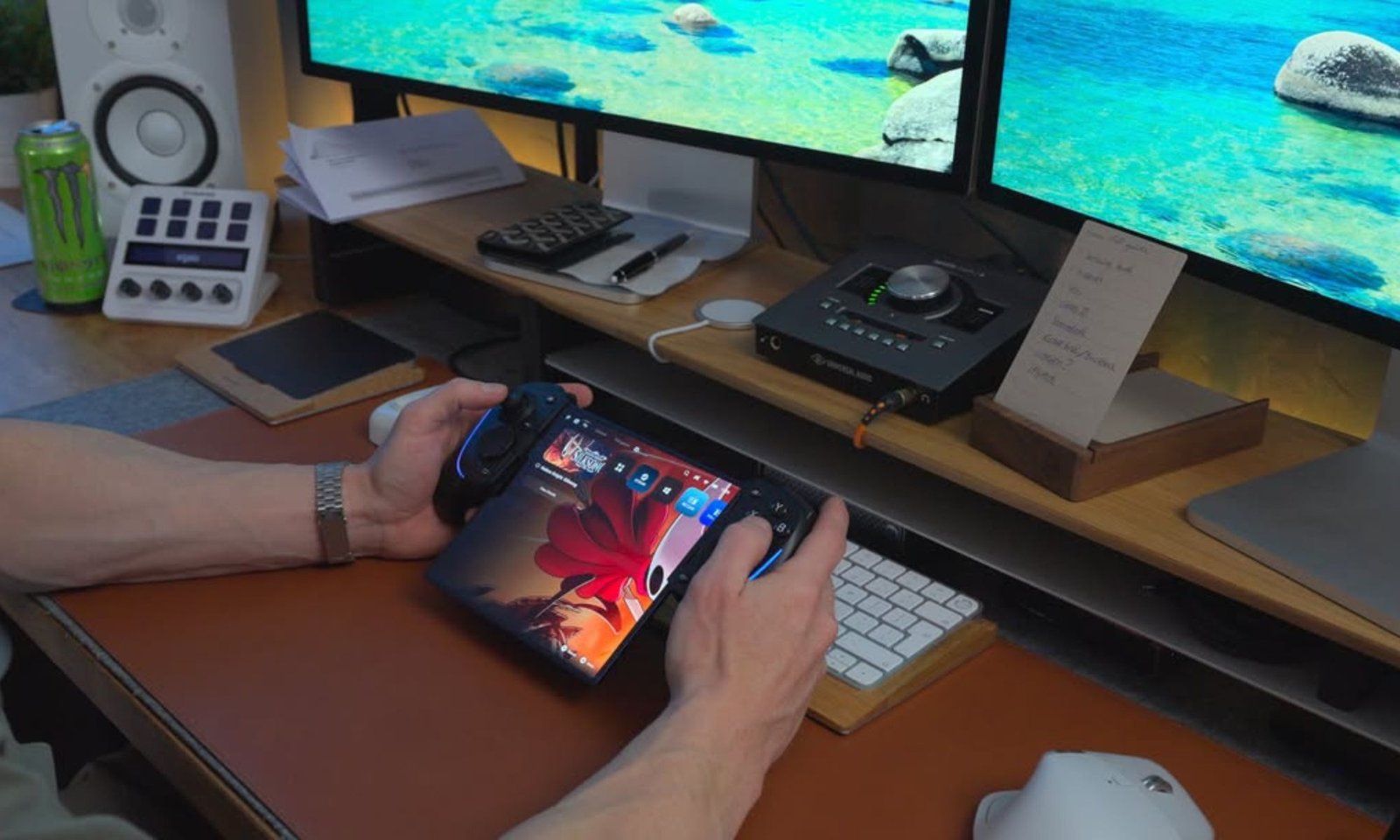
It’s autumn 2025. I sit in the departure lounge at Rome Fiumicino Airport and wait for my flight to Tirana, Albania. To my right, a middle-aged man faces the runway in full sea-trip gear. But he doesn’t just scroll on his phone.
He runs a mini desk setup.
Sure, if I tell you he uses the Samsung Galaxy Z Fold7, you might shrug. Big deal, right? But he takes it a step further. He props the phone up, pulls out a compact keyboard, and builds a pocket workstation right there at the gate. With Samsung and Apple set to unveil new foldables, the real question pops up: can a foldable phone replace a laptop?
Related: Samsung Wide Fold leaks point to 16:10 aspect ratio at a lower price
Four-Pocket Laptop concept
You may know the Four-Pocket Laptop idea, which YouTuber Michael Fisher brought into the spotlight in 2021. He started to test the concept when the Fold3 hit the scene. After he dropped the Fold3 onto his writer Bluetooth keyboard for a quick Twitter joke, curiosity kicked in.
He ordered a foldable keyboard, grabbed his Microsoft Arc Mouse, set up a phone stand, and built what he called a four-pocket laptop. So why carry extra gear instead of giving each device its own role? Why turn your phone into something it never tried to be?
Why I’d try it—and why I wouldn’t
Should you plug a keyboard into your phone at all? Simple. You free up screen space. The virtual keyboard no longer eats half the display. Fisher even said, “Although I have my MacBook with me, I don’t feel forced to use it.” That says a lot.
The Fold3 packs a 7.6-inch display. The Fold7 stretches that to 8.0 inches. That gives you room. Real room. You can read Kindle books, scan PDFs, review spreadsheets, or zoom into magazine pages without squinting at a cramped slab. But here comes the catch.
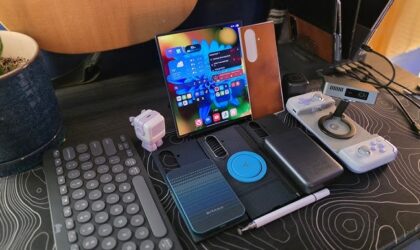
Samsung Galaxy Z Fold7
AI smartphone
Where the keyboard promise breaks
Keyboard support breaks down across apps. You can’t trust shortcuts like Enter to send a message. Arrow keys won’t always move the cursor. Samsung pushes Windows-style shortcuts, and many apps follow that pattern. Still, touch input creeps back in. Take Outlook or Teams as an example. In Outlook, K+M users can’t shift-select multiple emails. You must hold and drag your finger. Email drives my workflow. I sort messages from PR teams every day. I won’t rely on finger swipes to manage that pile. And the gaps don’t end there. In many apps, Z Fold users can’t depend on keyboard and mouse alone.
Logitech Keys-To-Go 2
Ultraportable keyboard with cover
When control feels slippery
A mouse sounds like the fix. It adds control, but it also adds friction. Pointer movement on Android feels off, especially on high-resolution screens. Of course, you can turn off “Enhance pointer precision” and tweak pointer speed. That helps a bit. Still, the experience falls short.
When I edit a blog post, I need accuracy. I won’t fight the cursor while I aim for a single sentence in a dense paragraph. Content editing takes focus. I don’t want to waste energy on clunky input.
Samsung DeX vs. a real computer
I own a MacBook Air. It packs more than enough power for my work. I don’t travel enough to justify a tablet, and I’m not ready to add another device to my bag. I could buy a foldable phone, pair it with a keyboard, mouse, and stand, and build a tiny workstation on the go. Samsung DeX covers a lot. If you can run it on a Chromebook, you can run it on DeX. Some people even tap into a remote PC and run a full desktop through it. In theory, that sounds awesome. In practice, it feels like a chore. Right now, that setup asks for patience I don’t want to give.
Know your workload
If you already own a foldable phone, and you don’t live inside heavy apps all day, I think you should try the keyboard route. Grab a compact keyboard, maybe a mouse and a stand, and you can knock out email, docs, light edits, and admin work without dragging a full laptop around. For airport waits, train rides, or a quick café stop, that setup makes a lot of sense.
But I won’t sugarcoat it. You will hit friction. Some apps still force you to touch the screen. Shortcuts fail at the worst time. Mouse input on Android can feel off. And battery life becomes your silent enemy. When you run DeX, connect Bluetooth gear, and push that big inner display, you burn through power. You need to think about chargers and power banks in a way you never do with a laptop built for long work blocks.
Grigor Baklajyan is a copywriter covering technology at Gadget Flow. His contributions include product reviews, buying guides, how-to articles, and more.
