

NERSC Issues 2026 Call for AI for Science Proposals
March 19, 2026 — NERSC invites proposals for projects that will leverage the Perlmutter supercomputer to push the state of the art in AI for science and produce novel science outcomes.
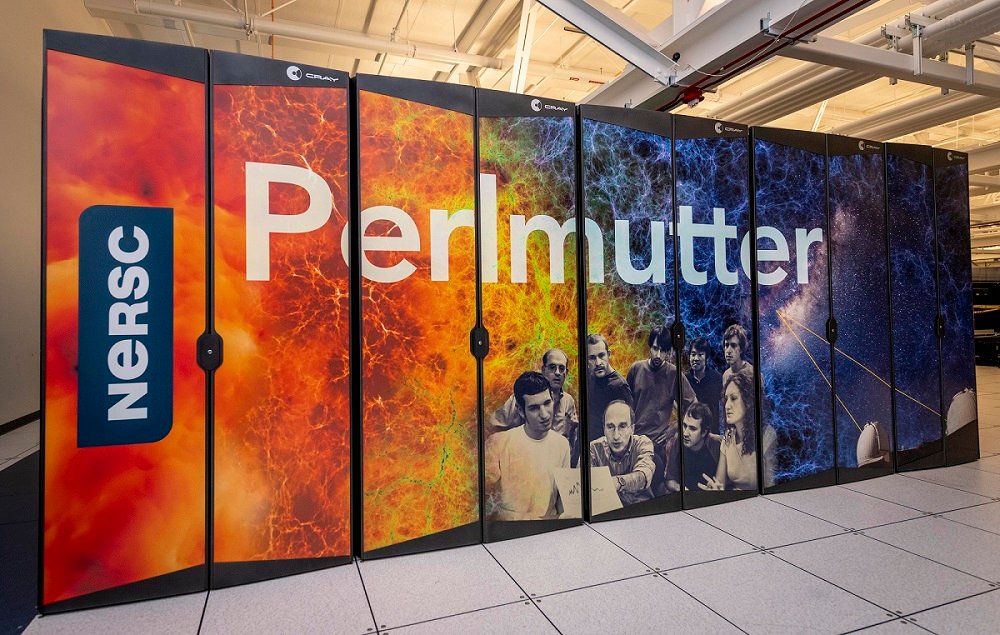
The Perlmutter supercomputer
NERSC is looking for teams with expertise in deep learning for science, a deep understanding of the scientific domain, and demonstrated proof-of-concept results.
This is an open call. It is not necessary to be a current NERSC user to submit a proposal.
Awards
Initially, up to 10,000 Perlmutter GPU node hours will be awarded to accepted projects (each Perlmutter GPU node contains four A100 GPUs) with associated storage quotas on NERSC’s file systems. Additional computer time and data storage may be available for projects that can demonstrate their ability to use them effectively.
NERSC staff assistance will be available for consulting on running effectively at NERSC, but not generally for model development.
NERSC also encourages applications to use Perlmutter’s CPU-only nodes to generate AI-ready datasets, with the expectation that these datasets will be publicly available. Up to 20,000 CPU node hours per project will be awarded to successful applicants, possibly more depending on resource availability.
All awards are for the NERSC 2026 Allocation Year, which runs through January 19, 2027.
Guidelines
Proposals should include the following:
- Well-defined project scope that includes relevant scientific background, objectives, methodology, and impact on the scientific community
- Computational resource requirements and utilization plan
- Team expertise, experience, as well as clear and specific deliverables, along with an expected timeline
Awardees will be required to report progress and summarize achievements to NERSC.
Criteria
Projects will be evaluated based on the following criteria:
- Scientific significance and innovation
- Degree of relevance to the missions of NERSC, Berkeley Lab, and the DOE Office of Science
- Technical feasibility of the proposed project
- Potential and readiness for effectively leveraging NERSC’s large computational resources at scale
- Clarity in scope, timeline, objectives, and track record of the research team
Apply Now
Proposals are now being accepted and reviewed on a rolling basis until all resources are awarded.
Submissions made by April 30, 2026 will be given full consideration.
Submit a proposal online here.
Contact
Please email your questions to the NERSC AI team.
About NERSC and Berkeley Lab
The National Energy Research Scientific Computing Center (NERSC) is the mission computing facility for the U.S. Department of Energy Office of Science, the nation’s single largest supporter of basic research in the physical sciences. Located at Lawrence Berkeley National Laboratory (Berkeley Lab), NERSC serves 11,000 scientists at national laboratories and universities researching a wide range of problems in climate, fusion energy, materials sciences, physics, chemistry, computational biology, and other disciplines. An average of 2,000 peer-reviewed science results a year rely on NERSC resources and expertise, which has also supported the work of seven Nobel Prize-winning scientists and teams. NERSC is a U.S. Department of Energy Office of Science User Facility.
Source: NERSC
Related

