

Argonne Advances AI-Enabled Rare Earth Separation with Aclara Partnership
Argonne and industry partners advance AI-enabled technologies to strengthen U.S. critical materials supply chains and accelerate domestic production
March 31, 2026 — As the United States expands artificial intelligence (AI), modernizes the electricity grid and grows advanced manufacturing, access to critical materials has become a national priority. Materials such as rare earth elements, lithium, cobalt and graphite are essential to these efforts. Today, many of them are still mined or processed overseas. This leaves U.S. manufacturers exposed to supply disruptions, price swings and geopolitical risk.
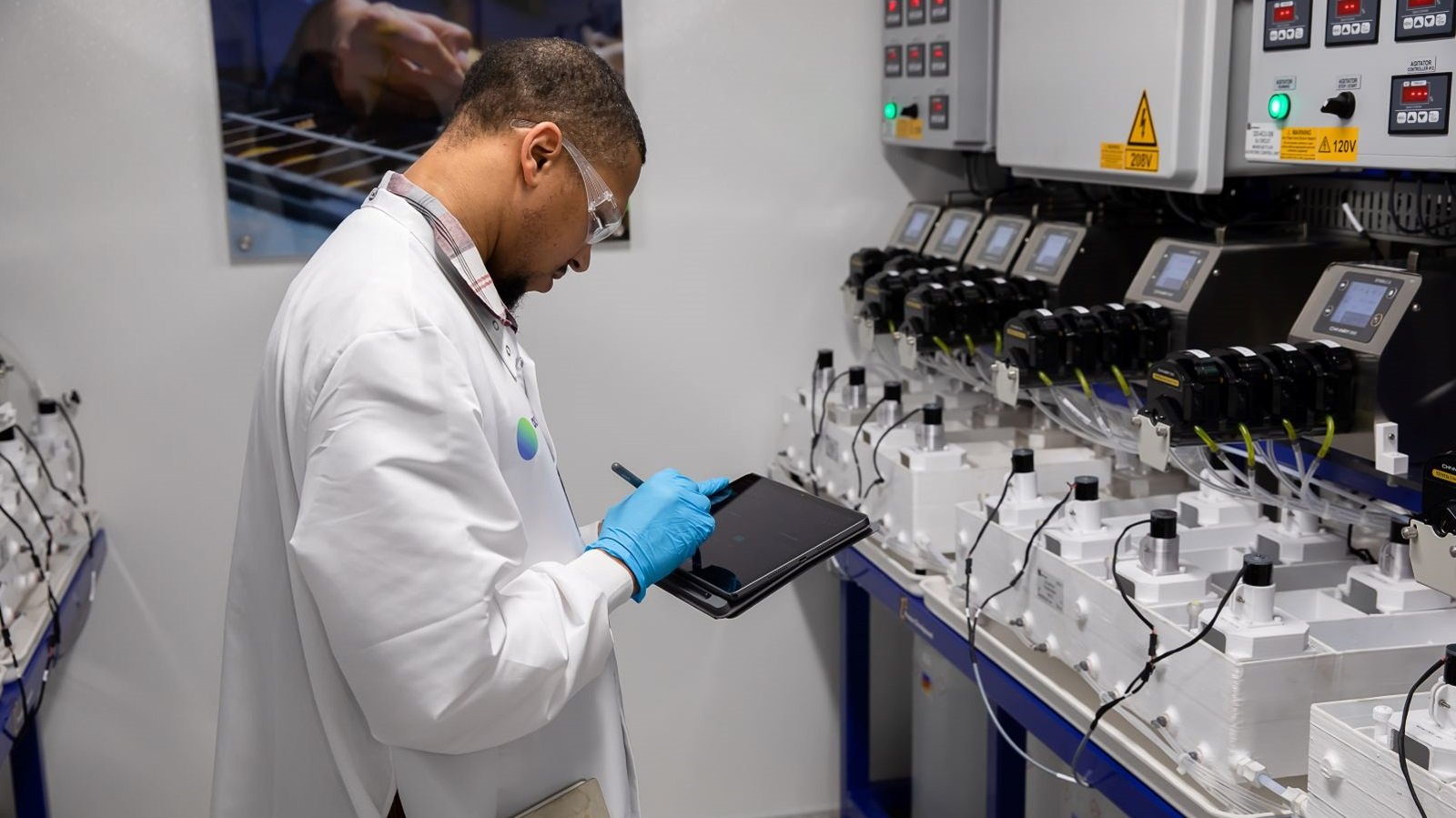
Aclara’s Rare Earth Separation Pilot Plant in operation. Image credit: Aclara.
To reduce these risks, the U.S. Department of Energy (DOE) is relying more heavily on public-private partnerships. Through its Office of Critical Minerals and Energy Innovation, DOE is linking federal research capabilities with industry-led deployment to help move new technologies from the laboratory into the marketplace faster.
As part of this approach, DOE’s Argonne National Laboratory is working with companies across the mining, processing, recycling and manufacturing value chain. These collaborations focus on developing technologies that make domestic production more efficient, resilient and economically viable.
Accelerating the Path from Science to Industry
One recent example is a Cooperative Research and Development Agreement between Argonne and Aclara Resources. The project centers on developing an AI-enabled digital twin for heavy rare earth separation. Argonne is applying its strengths in advanced computing, process modeling and AI to support the scale-up of separation technologies for Aclara’s pilot plant, which is being developed in partnership with Virginia Tech.
The goal is to help technologies reach industrial readiness faster. By pairing Argonne’s AI-powered process simulation platform with data from Aclara’s recently inaugurated rare earth pilot plant, the team aims to reduce both time and cost as operations move from pilot scale to commercial facilities. This transition is one of the biggest barriers to building new U.S.-based capacity.
The collaboration supports Aclara’s plan to build a $277 million heavy rare earth separation facility in Louisiana — the first of its kind in the U.S. with a secured ionic clay raw material feed. By the time production begins in 2028, Aclara expects to have more than a year of operational data from its pilot plant, enabling faster ramp-up, improved efficiency and stable long-term operations.
“By combining real-world industry needs with deep expertise in the science of scale-up at national laboratories, we can speed the deployment of advanced technologies that strengthen domestic supply chains,” said Claus Daniel, associate laboratory director for Argonne’s Advanced Energy Technologies directorate. “This work reflects Argonne’s role in building regional industrial innovation hubs, such as the Gulf Coast and the Midwest, by aligning research investments and leveraging complementary capabilities to support U.S. competitiveness.”
“This partnership with Argonne is a critical accelerator for Aclara’s strategy to establish a reliable U.S.-based supply chain for heavy rare earths,” said Ramon Barua, CEO of Aclara. “By combining our proprietary separation technology and pilot-scale data with Argonne’s world-class capabilities in advanced computing, we are significantly reducing scale-up risk, accelerating industrial deployment and strengthening the foundations of a secure domestic supply of these critical minerals.”
A National Strategy Built on Innovation and Partnerships
Partnerships like this are central to DOE’s broader approach to rebuilding domestic critical materials supply chains. Rather than relying only on traditional mining, DOE is supporting research that improves processing efficiency, unlocks new material sources and enables recycling and reuse at scale.
“We need new ways to source and process the materials that support our energy system,” said Audrey Robertson, Assistant Secretary of Energy who leads the Office of Critical Minerals, Materials, and Manufacturing. “That means investing in innovation that reduces risk for industry, shortens the path from the lab to the market, and builds supply chains that are secure, resilient, and based in the U.S.”
These efforts are already delivering results. Argonne and its industry partners are demonstrating pilot-scale processes and AI-enabled optimization tools that can be adopted directly by manufacturers. At full production, Aclara has indicated that its Louisiana facility could supply more than 75% of U.S. demand of dysprosium and terbium, significantly reducing reliance on overseas processing. These rare earth materials are used in high-strength magnets that allow for the efficient operation of electric motors.
By pairing federal research investments with industry execution, DOE and Argonne are helping create a new generation of U.S.-based critical materials supply chains. These supply chains are designed to deploy faster, withstand disruption and support long-term industrial growth. Rebuilding domestic capacity is no longer a distant goal. It is already underway, one partnership at a time.
Source: Argonne National Laboratory
Related


Argonne Advances AI-Enabled Rare Earth Separation with Aclara Partnership
Argonne and industry partners advance AI-enabled technologies to strengthen U.S. critical materials supply chains and…
NSF Initiative Aims To Make Every American Worker, Business and Community AI-ready
The NSF TechAccess: AI-Ready America initiative brings federal partners together to expand AI access for…
Red Hat and Google Cloud Expand OpenShift Integration, Add Virtualization on Dedicated Service
AMSTERDAM, March 27, 2026 — Red Hat has announced an expanded collaboration with Google Cloud to help organizations accelerate…
DOE Announces $320M Investment in Pioneering Scientific Research
WASHINGTON, March 27, 2026 — The U.S. Department of Energy (DOE) announced today, at the Office of Science…
Lumentum Announces New US Manufacturing Facility to Produce Advanced Lasers for AI Data Centers
SAN JOSE, Calif., March 27, 2026 — Lumentum Holdings Inc., a global leader in optical…
Argonne Researchers Develop AI System to Enhance Electric Grid Efficiency and Reliability
March 27, 2026 — Analyzing and managing the electric power grid are complex tasks. They…
