

NCSA, MechSE Develop GenAI Workflow for Metamaterial Design on DeltaAI
April 2, 2026 — Designing metamaterials consisting of engineered lattices whose geometry gives them unusual strength, flexibility, or energy absorption typically requires long cycles of trial‑and‑error simulation. The challenge becomes even harder when the structure combines multiple materials and must handle real-world behavior such as large deformations, plasticity, and contact, where many different designs can produce similar mechanical responses, deemed unsolvable by classical computational design methods.
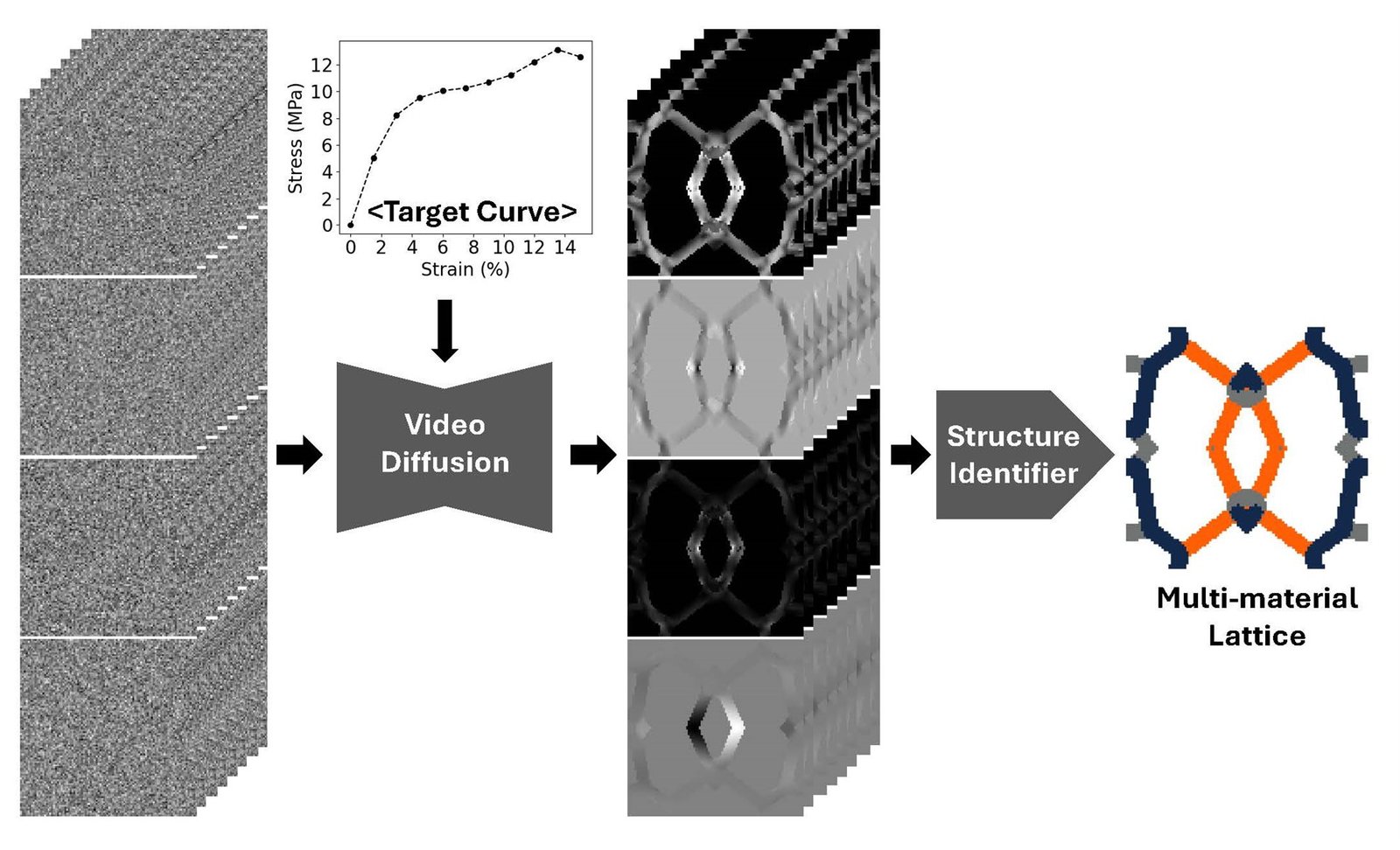
For a given target input stress-strain curve, the AI “thinks in reverse.” A video diffusion model de-noises from random noise into a plausible sequence of evolving internal mechanical fields, then a structure-identifier converts those fields into a manufacturable multi-material lattice — bypassing classical inverse computational design methods that are intractable.
Researchers from MechSE and the National Center for Supercomputing Applications (NCSA) have now introduced a generative AI workflow that is trained on NCSA’s DeltaAI high-performance computing system to reverse the process. Instead of starting with a design and predicting what it does, the method starts with the desired stress-strain curve and generates candidate multi‑material architectures that can deliver it.
The approach adapts video diffusion models, which are best known for producing images and videos for animated clips on social media. Through the process of noising and de-noising, the diffusion model learns how mechanical solution fields evolve during loading for a given stress-strain response, and an additional “structure identifier neural network” converts those fields into manufacturable multi‑material layouts.
This novel research was recently published in the Journal of Engineering Applications of Artificial Intelligence. It builds on research by Professor Dennis Kochmann’s group at ETH Zurich, which focused on a single-component material.
The ability to quickly propose many candidate structures with tailored nonlinear behavior opens doors to impact‑energy absorption for automotive and aerospace applications, soft‑robotics actuators that undergo large deformations, and bio-inspired materials that mimic tissue-like mechanics for implants, prostheses, and tissue engineering — all areas where customizable, nonlinear responses are crucial. MechSE Professor Iwona Jasiuk’s group is already moving toward the fabrication and testing of AI‑designed samples.
Jaewan Park led the project, co-advised by Jasiuk and Seid Koric, MechSE Research Professor and Senior Technical Associate Director at NCSA.
Other members of the team include former MechSE PhD students Diab Abuiedda, Junyan (Jimmy) He, and Shashank Kushwaha, as well as Qibang Liu, a research scientist at NCSA.
About Delta and DeltaAI
NCSA’s Delta and DeltaAI are part of the national cyberinfrastructure ecosystem through the U.S. National Science Foundation ACCESS program. Delta (OAC 2005572) is a powerful computing and data-analysis resource combining next-generation processor architectures and NVIDIA graphics processors with forward-looking user interfaces and file systems. The Delta project partners with the Science Gateways Community Institute to empower broad communities of researchers to easily access Delta and with the University of Illinois Division of Disability Resources & Educational Services and the School of Information Sciences to explore and reduce barriers to access. DeltaAI (OAC 2320345) maximizes the output of artificial intelligence and machine learning (AI/ML) research. Tripling NCSA’s AI-focused computing capacity and greatly expanding the capacity available within ACCESS, DeltaAI enables researchers to address the world’s most challenging problems by accelerating complex AI/ML and high-performance computing applications running terabytes of data. Additional funding for DeltaAI comes from the State of Illinois.
Source: Grainger College of Engineering Mechanical Science & Engineering, University of Illinois
Related

