

Berkeley Lab: How a Machine Learning Pipeline Could Accelerate Innovation
Feb. 2, 2026 — Lawrence Berkeley National Laboratory (Berkeley Lab) is working to transform petabytes of imaging data from advanced light and neutron scattering user facilities in the U.S. into actionable knowledge, demonstrating AI-accelerated advanced discovery capabilities that can be applied to energy, semiconductors, medicine, and other essential technologies.
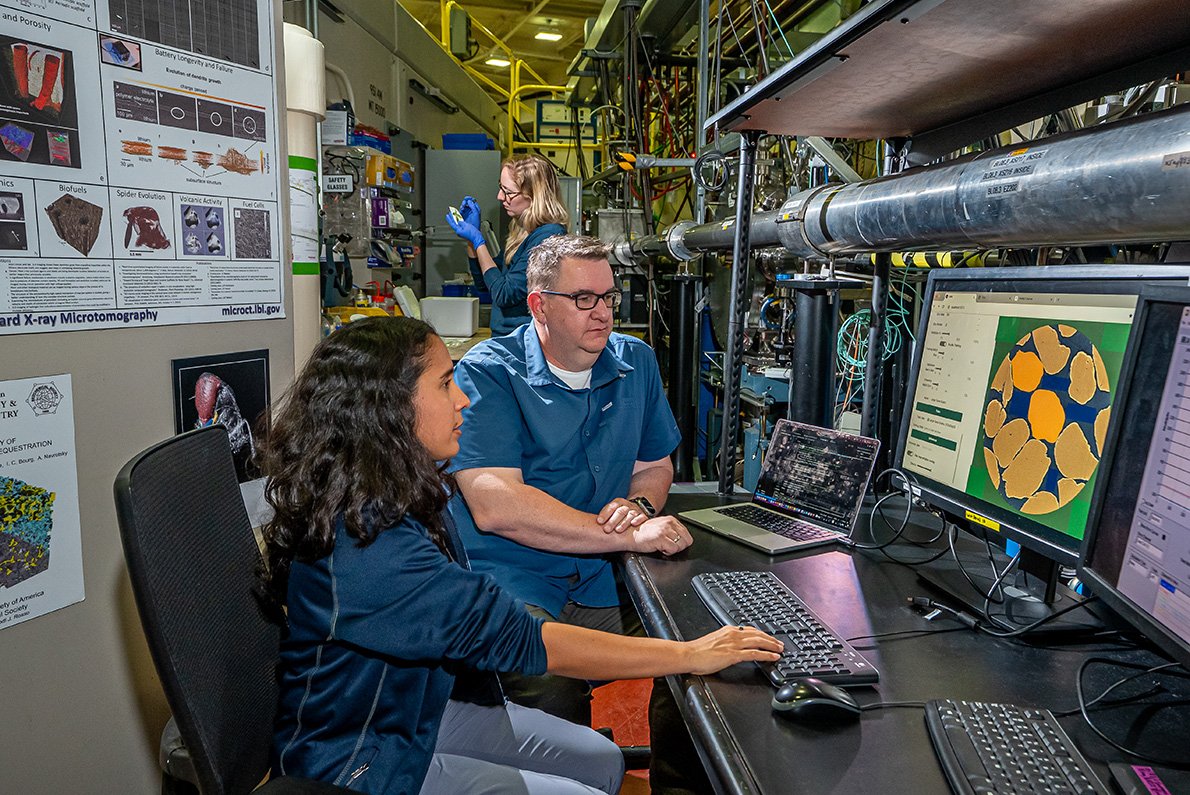
Alexander Hexemer, Tanny Chavez, and Liz Clark pictured at the ALS microtomography beamline with an AI-driven web interface that will be leveraged by SYNAPS-I. Credit: Marilyn Sargent, Berkeley Lab.
The multi-lab effort, called SYNAPS-I (SYnergistic Neutron and Photon Science – Intelligence), is part of the Genesis Mission, a new national initiative led by the Department of Energy to advance AI and accelerate discovery, providing solutions for challenges in science, energy, and national security. A cornerstone of the Genesis Mission is the Transformational AI Models Consortium, which will build and deploy self-improving AI models by harnessing DOE’s unique data, facilities, and expertise. SYNAPS-I is one of three AI model teams that Berkeley Lab leads or plays a key role in, building on AI expertise in high-performance computing, managing large datasets, and pioneering AI models in partnership with industry.
“Our national lab facilities are already world leaders in scientific discovery. SYNAPS-I will radically accelerate the path from experiment to insight by embedding AI directly into the analysis workflow,” said Alex Hexemer, a senior scientist at Berkeley Lab’s Advanced Light Source (ALS) and SYNAPS-I lead point of contact.
The SYNAPS-I platform will integrate large machine learning models as well as foundation models across all participating light and neutron sources, enabling unified analysis of imaging data from cutting-edge X-ray and neutron instruments at seven DOE Basic Energy Sciences user facilities, including the ALS, a synchrotron light source that produces X-ray, ultraviolet, and infrared light. The increased data outputs of recently completed and in-progress facility upgrades, such as Berkeley Lab’s Advanced Light Source Upgrade (ALS-U) project, bring even greater opportunities to accelerate scientific discovery across a wide range of disciplines.
SYNAPS-I is a public-private partnership uniting national laboratories, university researchers, and key industry innovators in AI, materials, pharmaceuticals, and energy, including partners from Berkeley Lab, Argonne National Laboratory, Brookhaven National Laboratory, SLAC National Accelerator Laboratory, and Oak Ridge National Laboratory.
“By pooling expertise and data across facilities, we can build AI capabilities that benefit all users and accelerate scientific discovery in ways that no single facility could achieve alone,” Hexemer said.
“SYNAPS-I marks the first step into an exciting new era for science at modern facilities. With the ALS — especially after the ALS-U upgrade — we’ll gain an unprecedented view into the inner workings of nature and technology. The challenge lies in turning that immense detail into knowledge that advances humanity. SYNAPS-I begins this next chapter of discovery,” said Dimitrios Argyriou, Interim ALS-U Project Director.
An Advanced AI Tool for X-ray and Neutron Science
X-ray microscopy and neutron scattering techniques help scientists study phase changes in the chemical composition and molecular makeup of active materials. This information can show how chemical processes and structural defects evolve in a material, and those insights can assist in the development of more durable materials for batteries and other useful applications.
Advances in automation for X-ray microscopy have allowed scientists to speed materials analysis for new applications. For example, more than a decade ago at the ALS, a collaboration of researchers used ptychography — a lensless, computational X-ray microscopy technique that analyzes the structure of a sample down to the atomic level — to image 5-nanometer structures in lithium iron phosphate, a material of interest for energy storage applications. That record-setting breakthrough allowed new understanding of the formation of defects in lithium iron phosphate during a chemical phase transformation.
Over the next few years, the multi-lab SYNAPS-I team wants to further accelerate knowledge extraction from X-ray microscopy and neutron scattering. To meet this goal, the team will build a machine-learning pipeline to augment existing algorithms for automated ptychography and image segmentation of X-ray and neutron data. Ptychography scans a sample with overlapping beam positions, collects diffraction patterns, and computationally reconstructs them into high-resolution images in 2D, or scans a sample from multiple angles to form a 3D image. Segmentation identifies patterns and features in X-ray and neutron imaging.
A battery material can be made up of millions of grains and particles. And with image segmentation done the traditional way, the painstaking manual process of identifying individual grains can take considerable time to complete. The SYNAPS-I AI platform will make this significantly easier and faster. By taking advantage of existing and to be developed AI solutions, SYNAPS-I will replace the tedious task of manual segmentation with an automated tool that segments and characterizes particles while you’re viewing the material at an X-ray or neutron beamline instrument.
“Automated segmentation in advanced microscopy is still a significant challenge in science. There are segmentation AI models available today for images of everyday objects, but they don’t work well for scientific data. We’re building SYNAPS-I to fill that gap,” Hexemer said.
Berkeley Lab is also contributing to other projects focused on AI code development, critical minerals and materials, cosmology, microelectronics, and quantum algorithms. Berkeley Lab’s contributions to the Genesis Mission build on decades of research in high-performance computing, managing large datasets, and pioneering AI models that yield insights across many science domains.
About Berkeley Lab
Lawrence Berkeley National Laboratory (Berkeley Lab) is committed to groundbreaking research focused on discovery science and solutions for abundant and reliable energy supplies. The lab’s expertise spans materials, chemistry, physics, biology, earth and environmental science, mathematics, and computing. Researchers from around the world rely on the lab’s world-class scientific facilities for their own pioneering research. Founded in 1931 on the belief that the biggest problems are best addressed by teams, Berkeley Lab and its scientists have been recognized with 17 Nobel Prizes. Berkeley Lab is a multiprogram national laboratory managed by the University of California for the U.S. Department of Energy’s Office of Science.
Source: Theresa Duque, Berkeley Lab
Related

Berkeley Lab: How a Machine Learning Pipeline Could Accelerate Innovation
Feb. 2, 2026 — Lawrence Berkeley National Laboratory (Berkeley Lab) is working to transform petabytes of…
Anthropic Launches Life Sciences Collaborations with Allen Institute and HHMI
Feb. 2, 2026 — Modern biological research generates data at unprecedented scale—from single-cell sequencing to whole-brain…

Moonshot AI’s Kimi K2.5 Expands What Open-Weight Models Can Do
Moonshot AI, a Beijing-based AI startup known for releasing large open-weight language models aimed at…
Argonne-Led Team Develops AI Framework to Coordinate Gravitational Wave and Radio Observations
A new AI-powered framework enables rapid, resource-efficient follow-up campaigns for a wider range of cosmic…
Dell Technologies Enables NxtGen to Build India’s Largest AI Factory
BENGALURU, India, Jan. 30, 2026 — Dell Technologies has announced that NxtGen AI Pvt Ltd,…
SCX.ai Launches Australia’s 1st Sovereign AI Inference Node in Sydney
SYDNEY, Jan. 30, 2026 — Australia’s first sovereign AI infrastructure node has gone live in Sydney,…
