

Argonne Helps Nuclear Industry Embrace AI to Speed Up Licensing and Reduce Delays
Three collaborative projects aim to streamline AI deployment in nuclear facilities.
Feb. 5, 2026 — Artificial intelligence (AI) is transforming industries. The U.S. Department of Energy’s (DOE) Argonne National Laboratory is using this technology to improve nuclear safety and efficiency.
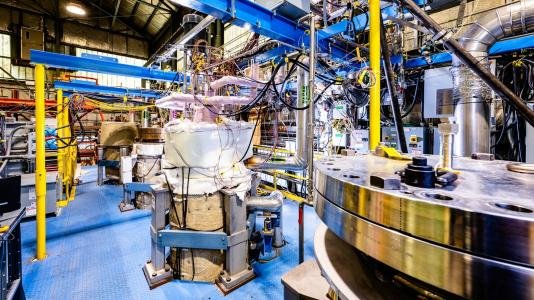
The Mechanisms Engineering Test Loop (METL) facility where Parameter-Free Reasoning Operator for Automated Identification and Diagnosis (PRO-AID) was successfully tested. Image credit: Jason Creps/ANL.
To ensure AI systems can be properly deployed in regulated environments, Argonne is advancing projects that are reshaping how regulation addresses cutting-edge technologies.
Three main projects are advancing this work:
- Developing and testing AI applications to improve efficiency of plant operations while maintaining the gold standard for safety.
- Creating a framework to speed up reactor licensing.
- Developing a tool to detect plant faults early.
These efforts emphasize both the innovative technologies under development and the broader impact on regulatory frameworks and safety measures.
Simulating AI Safety for Nuclear Regulation
Argonne researchers are working with the U.S. Nuclear Regulatory Commission (NRC) to explore how AI can be used in the nuclear industry. These AI tools have the potential to make operations more efficient, lower costs and improve safety. For example, AI could help predict when equipment needs maintenance, create better models for complex systems and optimize how facilities operate.
The researchers are testing an AI system at an experimental facility and putting it through a full regulatory review to see how it measures up to safety standards. This project helps connect the fast pace of AI development with the rules and safeguards needed to make sure these technologies can be used safely and securely in critical areas like the nuclear industry.
By developing tools and knowledge needed to evaluate and regulate AI technologies, Argonne is preparing the industry for the future.
Automating Licensing with AI-driven Protocols
Through a partnership with DOE’s Office of Nuclear Energy, Argonne is creating the Regulatory Context Protocol (RCP) to streamline the licensing process for advanced nuclear reactors. It automates applicant-regulator communication using AI agents that represent both the nuclear facility and the regulator. The RCP is designed to reduce delays in regulatory workflows, improve information quality and ensure compliance with NRC standards.
“The traditional licensing process can be a significant bottleneck for deploying advanced nuclear technology,” said Akshay Dave, manager of intelligent systems group and project lead. “With the RCP, we’re essentially creating a digital express lane for regulatory communication. By using AI to structure and automate this dialogue, we can dramatically reduce timelines and get nuclear energy onto the grid faster.”
By reducing delays in regulatory communication, the RCP will help meet accelerated licensing timelines. This ensures that advanced nuclear reactors can be deployed more quickly.
Advancing Fault Detection with Physics-Based AI
Argonne has also developed Parameter-Free Reasoning Operator for Automated Identification and Diagnosis (PRO-AID). PRO-AID is a physics-based AI tool that uses “digital twins” or virtual copies of nuclear power plant systems to identify unusual behavior in real-time. By integrating physical principles rather than relying on data alone, PRO-AID can spot faults such as sensor bias and cooling failures early.
PRO-AID was successfully tested in Argonne’s Mechanisms Engineering Test Loop (METL) facility. The tool’s real-time monitoring allows operators to fix issues before they cause downtime. These initiatives are vital steps toward ensuring that AI technologies can be successfully and safely integrated into the nuclear industry.
Impact on the Nuclear Industry
“By proactively identifying the relevant regulatory frameworks, we are advancing innovation while reinforcing public trust in the safety and reliability of these technologies,” said Rick Vilim, Argonne senior nuclear engineer.
Argonne’s work represents a critical intersection of innovation and regulation. Elements from these projects will help the nuclear industry embrace the potential of AI. These efforts are paving the way for safer, smarter and more cost-effective nuclear technologies.
From streamlining regulatory processes with the RCP to enhancing fault diagnostics with PRO-AID, Argonne is setting a standard for how emerging technologies can be responsibly integrated into high-stakes industries.
Source: Marguerite Huber, Argonne National Laboratory
Related

Argonne Helps Nuclear Industry Embrace AI to Speed Up Licensing and Reduce Delays
Three collaborative projects aim to streamline AI deployment in nuclear facilities. Feb. 5, 2026 — Artificial…
Cerebras Systems Raises $1 Billion Series H
SUNNYVALE, Calif., Feb. 4, 2026 — Cerebras Systems today announced the closing of a $1…
Positron AI Raises $230M Series B to Scale Energy-Efficient AI Inference
RENO, Nev., Feb. 4, 2026 — Positron AI, a leader in energy-efficient AI inference hardware, today…
TUM Unveils EU’s 1st 7nm AI Chip with Local Processing and RISC-V Architecture
Feb. 4, 2026 — The Technical University of Munich (TUM) has unveiled the EU’s first AI…
Gartner Forecasts Worldwide IT Spending to Grow 10.8% in 2026, Totaling $6.15T
STAMFORD, Conn., Feb. 4, 2026 — Worldwide IT spending is expected to reach $6.15 trillion…

SandboxAQ’s AQAffinity Changes the Workflow for Drug Affinity Prediction
Affinity, or how strongly a drug binds to a receptor, is an important early indicator…
