

University of Florida Advances Fusion Plasma Prediction with AI on HiPerGator
March 3, 2026 — Fusion research seeks to recreate on earth the processes responsible for powering the sun. Fusing atoms, which requires temperatures in excess of 100 million degrees Celsius, promises an abundant, carbon-free source of energy.
Credit: Shutterstock
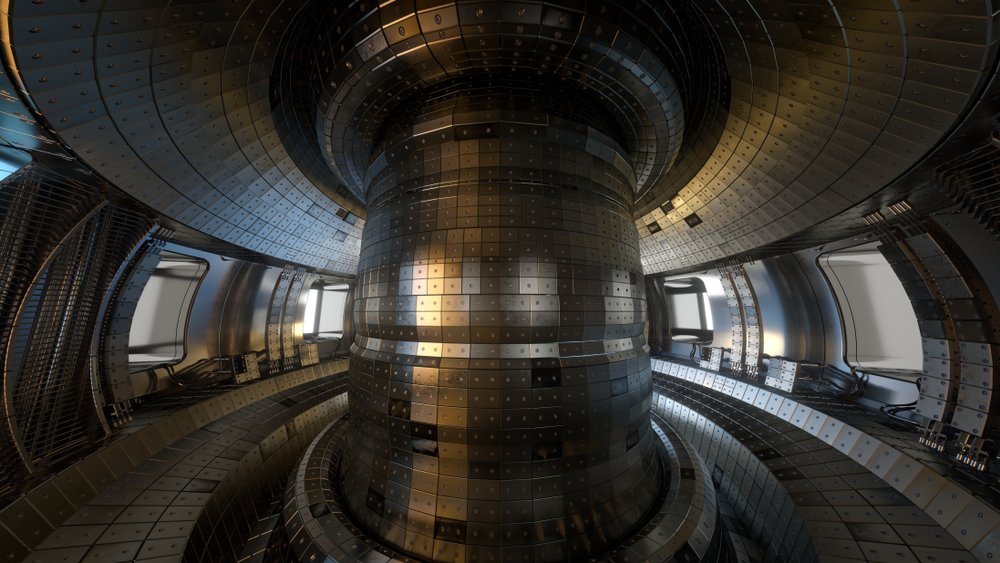
But first, researchers need to tame the beast — the ionized gas plasma held in magnetic fields inside a reactor known as a tokamak. Armed with recent federal grants, University of Florida researchers are working to do just that.
For Christopher McDevitt, Ph.D., a plasma physicist and professor in UF’s Nuclear Engineering program, understanding, predicting and ultimately preventing “off-normal” plasma behaviors inside a tokamak is the central challenge facing researchers around the world as they try to harness the energy released by fusing atoms together.
Two recent projects — one funded by the National Science Foundation, the other by the U.S. Department of Energy/National Nuclear Security Administration — are making strides toward improving the predictability of the plasma inside tokamaks using cutting-edge AI through UF’s supercomputer, HiPerGator.
Inside the tokamak reactor, the plasma’s extreme heat and magnetic confinement cause the fuel’s nuclei to collide and fuse, releasing massive amounts of energy that is absorbed as heat in the walls of the vessel. Just like a conventional power plant, a fusion power plant will use this heat to produce steam and then electricity by way of turbines and generators.
But if the plasma inside the reactor becomes unstable, bad things can happen.
“At those temperatures, if you were to suddenly lose control of the plasma, if all of that hot plasma were to suddenly hit a localized region of your reactor wall, it could do serious damage to the materials and structure,” McDevitt explained. “Or even worse would be the unintentional generation of energetic electrons. You can inadvertently turn your fusion device into a particle accelerator. It’s interesting physics, but it’s the nightmare scenario for tokamaks.”
Rather than using trial and error to determine the design parameters that yield the most stable plasma, researchers have turned to machine learning to simulate conditions inside the reactor, predicting plasma anomalies without risking damage to the reactor itself.
McDevitt’s group harnesses the power of HiPerGator to develop machine learning surrogates of these complex plasma events. The recently upgraded supercomputer allows for simulations that used to take days to be completed in a few minutes.
If unstable plasma can be accurately anticipated and ultimately prevented, all with the help of HiPerGator, clean energy powered by fusion could be one step closer to reality.
More from HPCwire
Source: Harrem Monkhorst, UF
Related


University of Florida Advances Fusion Plasma Prediction with AI on HiPerGator
March 3, 2026 — Fusion research seeks to recreate on earth the processes responsible for powering…
Argonne Applies AI to Speed Chemical Analysis at DOE’s Advanced Photon Source
AI-guided approach takes over manual steps in powerful X-ray technique March 2, 2026 — Artificial…
OpenAI and Amazon Announce Strategic Partnership
SAN FRANCISCO and SEATTLE, Feb. 27, 2026 — OpenAI and Amazon today announced a multi-year strategic partnership to accelerate…
SDSC Powers AI Model to Improve Prostate Cancer Care
Feb. 27, 2026 — Researchers and clinicians from six leading medical centers and academic institutions…
Lilly Launches LillyPod NVIDIA DGX SuperPOD for Genomics and Drug Discovery AI
Built with over 1,000 NVIDIA Blackwell Ultra GPUs, LillyPod is now online to power scientific…
Domino Introduces Fastest, Safest Path to Scale Enterprise Agentic AI Systems
SAN FRANCISCO, Feb. 27, 2026 — Domino Data Lab has announced a major new platform…
