

Argonne to Lead $2.8M Project to Accelerate Catalyst Discovery
The Accelerated Catalyst Design Foundry will combine AI, autonomous laboratories and pilot plan testing to help move promising catalyst technologies more quickly toward industrial use.
May 29, 2026 — Catalysts help make modern life possible. They quietly drive the chemical reactions that produce fuels, fertilizers, plastics and many other industrial products. But developing a new commercial catalyst can take as long as two decades.
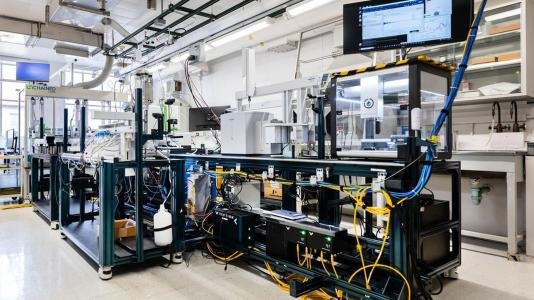
Artificial intelligence, automated laboratories and rapid testing at Argonne accelerate the discovery of new catalysts as part of the Accelerated Catalyst Design Foundry. Image credit: Argonne National Laboratory.
That timeline may soon change. The U.S. Department of Energy’s (DOE) Argonne National Laboratory has received $2.77 million from DOE’s Advanced Research Projects Agency-Energy (ARPA-E) to help launch the Accelerated Catalyst Design Foundry, or the ACDF. The goal is to cut the time needed to discover and commercialize new industrial catalysts from 15–20 years to less than five years.
The project will combine artificial intelligence (AI), automated laboratories, rapid testing and pilot-scale evaluation. Together, these tools can replace the slow process of trial and error with a faster and more direct path to industrial use.
A catalyst is a material that helps a chemical reaction happen faster without being used up. Catalysts are needed to make fuels and many industrial chemicals used in everyday products. Better catalysts could help manufacturers use less energy, lower costs and make production more efficient.
ACDF will use AI, automated experiments and rapid testing to develop catalysts that can turn waste materials into useful products. These materials include methane from biological sources, plant-based materials, food and plastic waste, and carbon dioxide captured from industrial sites. The goal is to turn them into raw materials for chemicals and plastics, such as methanol and ethanol.
“Catalysts are essential to making many of the fuels, chemicals and materials people rely on every day,” said Max Delferro, chemist and group leader at Argonne and principal investigator for the project. “But discovering better ones has traditionally been a slow and costly process. By combining AI, automation and rapid experimentation, we aim to find promising new catalysts much faster and help move them more quickly toward real-world use.”
A central part of the effort is the Catalysis Data Library. This shared resource will bring together catalyst data from experiments, computer modeling and published studies. By organizing the data in a form AI can use, the library will help researchers find promising catalyst designs, choose better test conditions and make smarter decisions about what to study next.
ACDF uses a closed-loop approach, meaning each round of design, testing and analysis helps guide the next one — a continuous cycle of improvement. This will help researchers quickly design, test and improve thousands of possible catalyst combinations, speeding the path from early discovery to practical use.
Another key part of the project is Argonne’s use of autonomous, or “self-driving,” laboratories. These labs use robotics, automation and AI to run experiments, analyze results and decide what to test next. Combined with rapid, large-scale testing, the approach can help researchers evaluate and improve catalysts much faster than traditional methods.
The project brings together experts and specialized facilities from across the country, including partners at DOE’s SLAC National Accelerator Laboratory, Johns Hopkins University, GTI Energy, Lila Sciences and Johnson Matthey. It will build on Argonne’s strengths in AI, automated research and materials science, along with the capabilities of two DOE Office of Science user facilities: the Advanced Photon Source and the Argonne Leadership Computing Facility.
“Argonne is at the forefront of empowering domain scientists to harness AI for transformative discoveries,” said Kawtar Hafidi, associate laboratory director for Argonne’s Physical Sciences and Engineering directorate.
The ACDF is one of 12 projects selected for funding through ARPA-E’s CATALCHEM-E program. Through this $34 million effort, ARPA-E is supporting projects that pair AI with self-driving laboratories to speed the development of better catalysts for making fuels and chemicals. The program is designed to modernize how catalysts are discovered, tested and used in U.S. manufacturing.
About Argonne National Laboratory
Argonne National Laboratory seeks solutions to pressing national problems in science and technology by conducting leading-edge basic and applied research in virtually every scientific discipline. Argonne is managed by UChicago Argonne, LLC for the U.S. Department of Energy’s Office of Science.
Source: ANL
Related


Yann LeCun’s AMI Secures $1B Seed to Develop AI World Models
Turing Award–winning AI researcher Yann LeCun has spent years arguing that large language models, at…

Broadcom Announces VMware Cloud Foundation 9.1
PALO ALTO, Calif., May 5, 2026 — Broadcom Inc., a global technology leader that designs,…

Deloitte’s State of AI 2026: Why Enterprise Execution Is Falling Behind Adoption
Deloitte’s latest State of the AI report shows that AI adoption continues to accelerate rapidly,…
Anthropic Unveils ‘Project Glasswing’ as Claude Mythos Targets Software Vulnerabilities
April 9, 2026 — Anthropic has announced Project Glasswing, a new initiative that brings together Amazon…

Google Unveils Gemini Enterprise Agent Platform, Expands Vertex AI into Full Agent Stack
At Google Cloud Next 2026 in Las Vegas this week, the company announced major changes…

OpenAI Shutters Sora, Shifts Business Strategy Ahead of IPO
Back in 2022, OpenAI set off a chain reaction in the tech world when it…

Argonne to Lead $2.8M Project to Accelerate Catalyst Discovery
The Accelerated Catalyst Design Foundry will combine AI, autonomous laboratories and pilot plan testing to…
Anthropic Raises $65B in Series H Funding at $965B Post-Money Valuation
May 29, 2026 — Anthropic has raised $65 billion in Series H funding led by Altimeter…
NIST Expands AI Consortium’s Scope, Calls for New Members
May 29, 2026 — To broaden its support of collaborative research in artificial intelligence (AI), the…
IBM and Red Hat Commit $5B to AI-Powered Open Source Security Initiative
Project Lightwell establishes a trusted enterprise clearinghouse for open source software with a new AI-driven…
ROVI DataHub Unifies Energy Storage Data to Accelerate Long Duration Battery Innovation
Led by ORNL, the DataHub supports AI-driven workflows for lifetime prediction, anomaly detection and digital…
Compal and GMI Cloud Announce Collaboration on AI Infrastructure Development
TAIPEI, Taiwan, May 28, 2026 — Compal Electronics Inc. has announced its collaboration with GMI…
