

TPC26 Panel Explores AI’s Impact on Science, Productivity and Global Collaboration
Can AI help science move faster without sacrificing openness and collaboration? How to measure ROI in AI for science? What are some of the most effective strategies for collaboration among national and regional initiatives? Those questions were at the center of a discussion at the TPC26 panel featuring senior representatives from some of the world’s leading research and computing organizations.
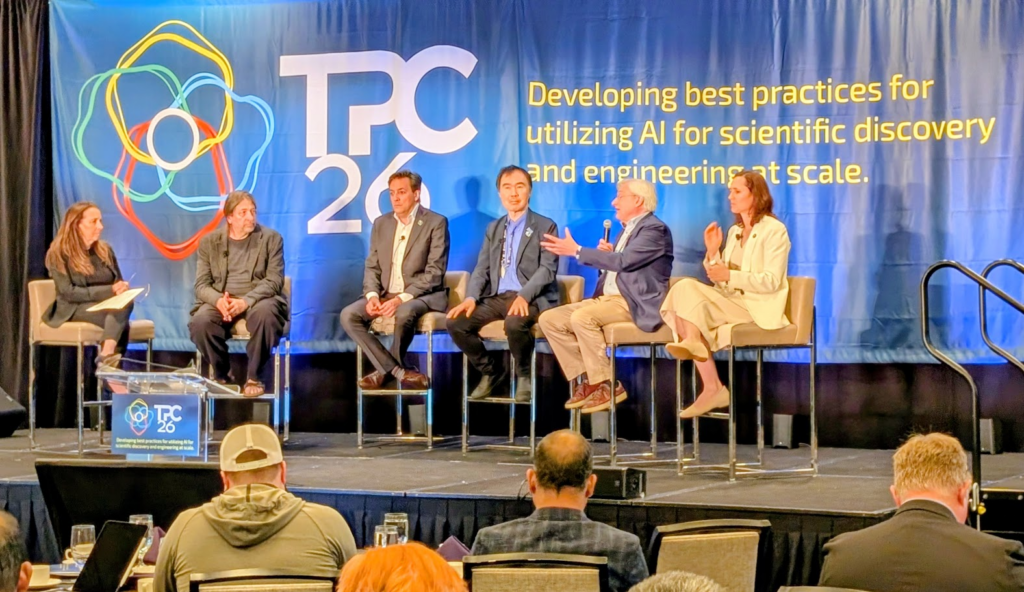
The session brought together Dario Gil of the Department of Energy, Katie Antypas of the National Science Foundation, Rick Stevens of Argonne National Laboratory, Satoshi Matsuoka of RIKEN, and Per Oster of IT Center for Science. Debra Goldfarb from AWS served as the moderator.
Over the course of the discussion, panelists explored how AI is changing the economics of scientific research. This includes the growing importance of international partnerships and the challenges of balancing collaboration with national interests. They also debated how governments and research organizations should measure the impact of billions of dollars in scientific infrastructure investments as AI becomes increasingly central to scientific discovery.

(S. Singha/Shutterstock)
TPC26 panelists discuss the challenges and opportunities of applying AI to scientific research at scale.
Measuring AI’s impact on scientific research and discovery was one of the first themes to emerge during the discussion. While publications and scientific breakthroughs remain central indicators of success, the panel argued that they no longer provide a complete picture of the value created by large research programs.
As public investments in AI and advanced computing continue to grow, governments increasingly want to understand how those programs contribute to innovation and socio-economic competitiveness. However, the challenge is that those outcomes often take years to materialize.
That task may become even harder as AI spreads across education and industry. The broader the technology’s influence becomes, the more difficult it may be to quantify its impact using traditional measures.
The conversation then shifted from measuring scientific impact to actually improving it. The speakers argued that AI’s greatest contribution to science may not be any single breakthrough – but its ability to make researchers more productive and help them solve complex problems faster.
That theme was also clear in discussions about national competitiveness.
As populations age and research talent becomes increasingly scarce in some countries, simply adding more scientists to the workforce may no longer be enough to maintain innovation. AI could help researchers accomplish more with existing resources.
Productivity gains emerged as one of the most important benchmarks for evaluating the technology’s long-term impact. However, how to measure the true impact?
The panel suggested that success in AI for science should ultimately be measured by whether AI allows scientific challenges to be solved faster, at lower cost, with higher quality results, or other meaningful outcomes.
The discussion naturally evolved from productivity to collaboration. While AI may help researchers accomplish more with existing resources, panelists argued that many of the most important scientific challenges will still require countries to work together.
Participants also highlighted several factors driving the need for greater international collaboration. This includes the growing cost of AI infrastructure, the increasing complexity of scientific research, and the need for specialized expertise across multiple disciplines. These factors are making international collaboration less of an option and more of a necessity.
Some of the examples discussed during the session included European initiatives, such as the EuroHPC, designed to coordinate investments across national programs while maintaining close ties to local research communities.
The conversation also focused on partnerships between the U.S., Europe, and Japan. The panelists admitted that competition remains an important driver of innovation. However, they argued that future success will depend on the ability to share expertise and build research capabilities together. They highlighted a key element for this to happen – alignment of priorities.
The speakers emphasized that meaningful collaboration requires more than state-level agreements and formal partnerships. It requires a more open system – one with shared infrastructure and interoperable systems.
When asked about how they see the landscape changing by 2030, the panelists shared that they envision a future where AI is far more deeply embedded in scientific research. And the only way that will happen is with broader access to advanced computing resources and stronger global partnerships.
A key theme with the panel was that AI has the potential to transform the way science is conducted, and in many ways it already is. However, measuring and improving the impact of AI and international collaboration will become even more important as the technology scales.
Related


Broadcom Announces VMware Cloud Foundation 9.1
PALO ALTO, Calif., May 5, 2026 — Broadcom Inc., a global technology leader that designs,…

Yann LeCun’s AMI Secures $1B Seed to Develop AI World Models
Turing Award–winning AI researcher Yann LeCun has spent years arguing that large language models, at…
Anthropic Unveils ‘Project Glasswing’ as Claude Mythos Targets Software Vulnerabilities
April 9, 2026 — Anthropic has announced Project Glasswing, a new initiative that brings together Amazon…

Google Unveils Gemini Enterprise Agent Platform, Expands Vertex AI into Full Agent Stack
At Google Cloud Next 2026 in Las Vegas this week, the company announced major changes…

OpenAI Shutters Sora, Shifts Business Strategy Ahead of IPO
Back in 2022, OpenAI set off a chain reaction in the tech world when it…
Cerebras Systems Announces Launch of Initial Public Offering
SUNNYVALE, Calif., May 4, 2026 — Cerebras Systems, Inc. today announced that it plans to commence…

TPC26 Panel Explores AI’s Impact on Science, Productivity and Global Collaboration
Can AI help science move faster without sacrificing openness and collaboration? How to measure ROI…

NIST Researchers Develop AI Model to Guide Building Evacuations During Fires
June 5, 2026 — A fire alarm jolts you from your office desk, and you head…
Hitachi and Intel Explore New Physical AI Applications Across Critical Industries
TOKYO and SANTA CLARA, Calif., June 5, 2026 — Hitachi, Ltd. and Intel Corporation today…
Cohere Shares Internal Visualization Tool with Open-Source Community
June 5, 2026 — Cohere has announced the public release of co/plot, an open-source data…
Dnotitia Releases DNA 3.0, an Enterprise-Ready AI Language Model Family
SEOUL, South Korea, June 5, 2026 — Dnotitia Inc., a company specializing in long-term memory…
EU Proposes Tech Sovereignty Package to Strengthen Europe’s Digital Autonomy and Resilience
June 4, 2026 — The European Commission has presented the European Technological Sovereignty Package, a set…
