
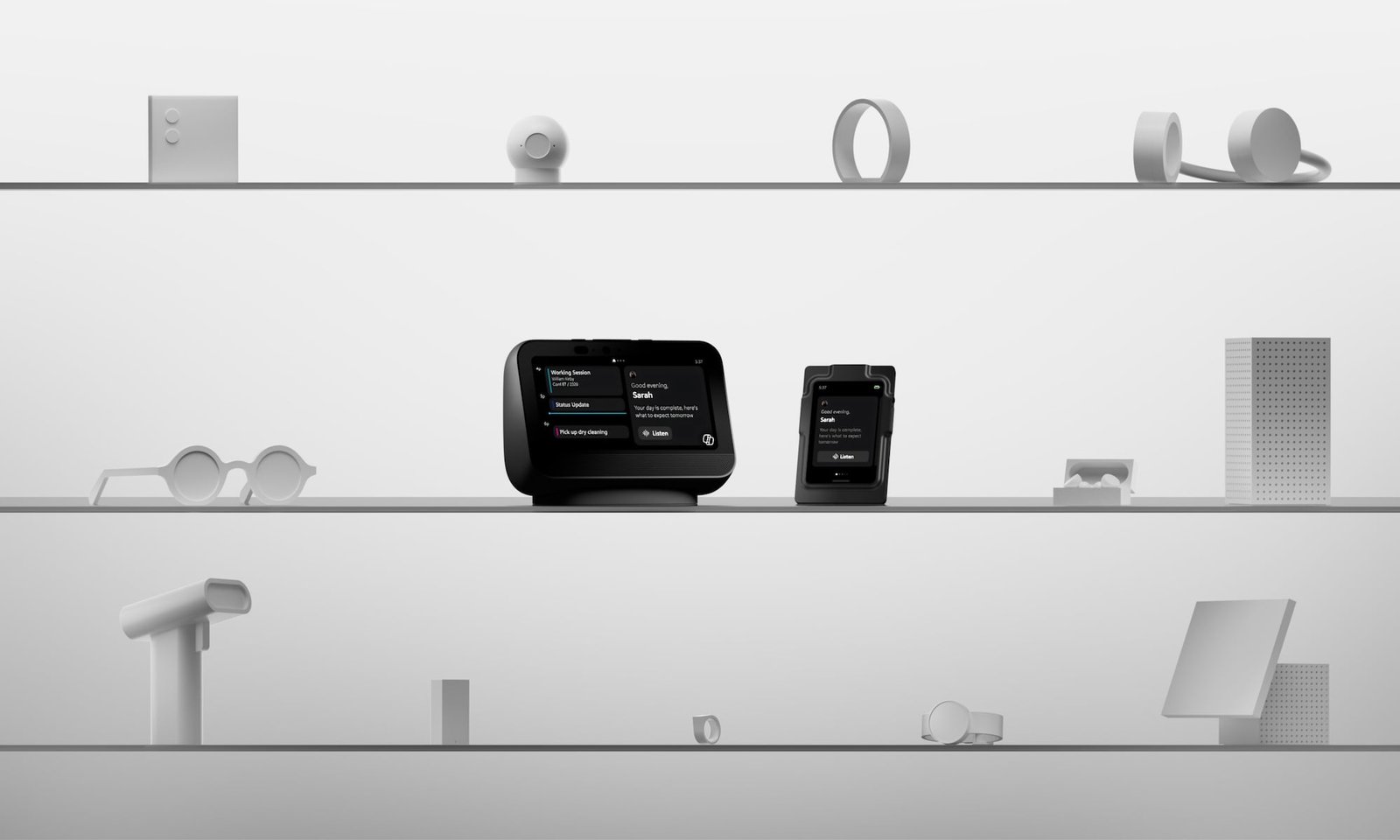
When Microsoft announced Microsoft Project Solara at Build 2026, most coverage zeroed in on the hardware: a smart badge you clip to your lanyard, a companion device that lives on your desk. Cool concepts, sure. But if you actually read through the full announcement — every word of it — you start to realize the devices are almost beside the point.
What Microsoft is really describing is something far more ambitious: a future where apps are optional, and AI agents handle workflows across tools and devices. I’ve been covering tech long enough to know when a company is trying to sell you a gadget versus when they’re trying to rewire how computing works. This one feels like the latter.
Microsoft Is Describing a Post-App Future
The language in the Solara announcement is deliberate. The platform’s stated mission is to move computing “from apps to agents — from software you open to intelligence you invoke.” That’s a complete reframe of how software is supposed to work.
For decades, computing has meant roughly the same thing: open an app, navigate its interface, complete a task, close it, open the next one. Even smartphones, which felt revolutionary, didn’t change this loop. They just made it faster and put it in your pocket. The app model has been the dominant paradigm since the 1980s, and we’ve accepted it as the price of using a computer.
What Microsoft is proposing with Solara is a different model entirely. Instead of opening Outlook, then Teams, then Word, then Excel — you tell an agent what you need, it figures out the workflow, coordinates the tools, and you review the output. Microsoft frames this as agents becoming “a new unit of programming and the new unit of human-to-machine interfaces.” That’s a bold claim. But when you look at how they’re building the platform — the Agent Shell, the agent dispatcher, the task manager, the just-in-time UI layer — it becomes clear they’re not just talking. They’re actually building for this.
AI Agent Devices Are the Next Step in the Long History of Interfaces
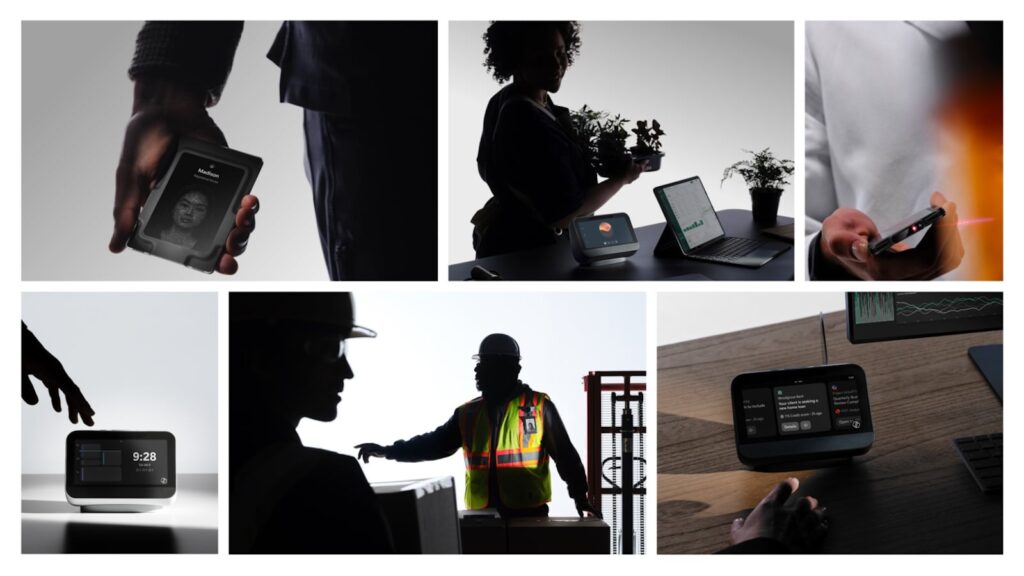
Every major shift in computing has meant changing how we talk to machines. The command line replaced punch cards. The GUI replaced the command line. Touchscreens replaced the mouse for mobile. Voice assistants were the next push — Siri, Alexa, Google Assistant — though they mostly stalled out at setting timers and playing music.
AI agents are the next step in this progression. And like every prior shift, they don’t make the previous generation disappear. As Microsoft notes in the Solara press release, “Mainframes did not disappear when PCs arrived. PCs did not disappear when phones arrived.” What changes is what lives at the center of people’s computing lives.
The reason this shift feels significant is something Microsoft puts plainly: people don’t care about software. They care about outcomes. If I need to prep for a meeting, I don’t want to open five apps and manually compile information. I want something to do that for me and show me what actually matters. AI agents promise to move computing closer to outcomes and further from tool management. That’s intriguing, even if execution is still catching up to the vision. We’ve been tracking AI wearables and companion gadgets throughout 2026, and the theme keeps emerging: people want tech that reduces cognitive load, not stuff that adds to it.
The Most Interesting Idea in Project Solara Isn’t the Hardware
Everyone’s talking about the badge and the desk companion. They’re photogenic, sure, and they’re tangible. But the concept that actually keeps me thinking is something Microsoft calls “just-in-time UI.”
Here’s the problem it’s trying to solve: historically, every new hardware form factor has required a completely custom software stack. New screen size? You need a new UI. New form factor? You need new apps, new developer SDK, new everything. This is one of the main reasons new device categories are so expensive to create — and why most of them fail. Building a new computer means rebuilding nearly everything.
Just-in-time UI is Microsoft’s answer: instead of pre-building interfaces for every possible device, it lets AI generate or adapt the interface on the fly based on the device it’s running on. The same agent could render a glanceable card on a small badge screen, a voice interaction through a speaker, and a full dashboard on a connected monitor — without developers having to design three separate experiences. As The Next Web reported, this is core to the Solara platform’s value proposition: an “OS for agent-first devices” where the interface adapts to context rather than demanding developers rebuild for each form factor.
Microsoft positions this as a spectrum — from traditional responsive UI on one end to fully generative AI-generated interfaces on the other. They’re building for the middle ground right now: it’s structured enough to be reliable, flexible enough to work across form factors.
Whether just-in-time UI fully works remains to be seen. The idea that AI can generate reliable, accessible, contextually appropriate interfaces on the fly is still largely theoretical at scale. We’ve seen versions of this promise before, and the reality is always messier than the pitch. But if Microsoft gets even halfway there, it could dramatically lower the cost of building specialized devices — and that changes hardware economics in important ways.
Why Agent-First Devices Might Finally Make Sense — When Everything Else Has Failed
Let’s be honest about the track record here. AI hardware has been mostly a disaster. The Humane AI Pin raised $230 million and sold the company for $116 million after shipping fewer than 10,000 units, with its servers shut down in February 2025. The Rabbit R1 sold 100,000 units and ended up with around 5,000 daily active users. Meta’s Ray-Ban smart glasses are the closest thing to a success story in the category, and they’re essentially fashionable earbuds with a camera. According to reporting on AI hardware failures, 85% of AI hardware startups failed by 2025. The pattern was consistent: cool idea, unclear purpose, weak ecosystem, quick abandonment.
So why might Microsoft Project Solara be different? A few reasons. First, Microsoft wants to build a platform, not a product . The badge and desk companion are reference designs, proofs of concept that show what the platform enables. The actual devices will come from OEMs, specialized for specific industries and workflows. That’s a fundamentally different approach than Humane or Rabbit, which were betting everything on a single device.
Second, Microsoft already has the software ecosystem that previous AI hardware attempts lacked. Solara plugs directly into Microsoft 365 Copilot, Teams, Outlook, and Azure — existing products with hundreds of millions of users. When your badge taps into your actual work context through WorkIQ, it’s running on real data.
Third — and this is where it gets interesting — Microsoft is targeting enterprises first. And that’s actually the smart move. Our roundup of the best new AI gadgets to look forward to shows how crowded and uneven the consumer AI hardware space looks right now. Microsoft is sidestepping that minefield entirely.
Why Enterprise Could Be the Real Winner Here
Microsoft’s private pilot program includes AccuWeather, Best Buy, CVS Health, Levi’s, and Target. Notice what’s not on that list: consumers. The industries Microsoft explicitly calls out — healthcare, retail, field service, financial services, legal, hospitality — share a few important characteristics.
Workers in these environments switch contexts constantly. A nurse moves between patients, systems, and tasks dozens of times per hour. A retail associate fields inventory questions, customer requests, and scheduling conflicts simultaneously. A field service technician might be crawling under equipment while trying to pull up a manual. None of these people are sitting at a PC, and many of them don’t have the time or bandwidth to navigate complex software interfaces. TechRadar’s coverage of Project Solara framed it well: this is about “breaking AI out of the PC and into the real world.” An agent that surfaces the right information at the right moment — through a badge clip or a desk companion — isn’t a luxury for these workers. It’s potentially transformative.
Dragon Copilot, which is exploring Solara integration for healthcare, is a clear example. Physicians and nurses spend enormous amounts of time on documentation — time that could be spent on patient care. An agent-first device that captures interactions, surfaces relevant information in context, and follows through on tasks without requiring the clinician to touch an app could actually change how healthcare is delivered.
Enterprise has always been where Microsoft is strongest. Selling to IT departments, managing devices through Intune, authenticating through Entra ID — this is Microsoft’s home turf. Project Solara is built on these foundations because enterprise adoption is both the most credible path to market and the least risky bet Microsoft can make.
The Bigger Ambition: Microsoft May Be Building an AI Operating System
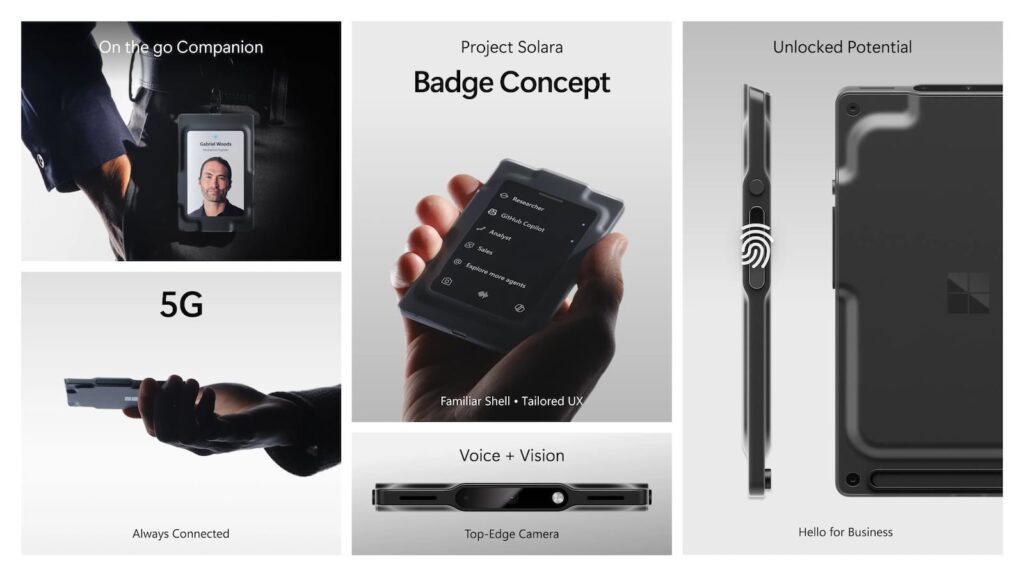
Here’s the question that keeps nagging at me as I read through the Solara announcement: if agents coordinate tasks, manage context, and operate across a constellation of devices — what exactly is that, if not an operating system?
Microsoft doesn’t explicitly call Solara an AI OS. The language is careful: “chip-to-cloud platform,” “liminal operating system,” “Agent Shell.” But look at what’s actually in the stack. There’s MDEP, an enterprise-grade OS built on AOSP. An Agent Shell that dynamically loads and tailors cloud-based agents. An agent dispatcher and agent task manager that automatically activate and coordinate specialized agents. Entra ID for identity. Intune for device management. Azure for long-running state across a “constellation of specialized devices.” Biometric authentication through Hello for Business.
As GeekWire noted in their deep-dive, Solara is “a new platform for devices that run AI agents instead of apps” — and that matters more than you might think. This is the architecture of an entire platform, and closely resembles what Windows was in the 1990s: a layer that abstracted hardware complexity, provided common services, and created a surface for developers to build on. The difference is that Windows abstracted the hardware, and Solara abstracts the agent coordination layer. Where Windows gave you a file system, Solara gives you WorkIQ — a contextual data layer that grounds your agents in your actual work.
This also explains the insistence on “chip-to-cloud.” They’re describing a computing model where the device is the edge node in a larger intelligent system. The OS in the Solara world doesn’t live on your device — it spans from the badge’s silicon to the Azure services that manage your agent’s long-running tasks. It’s worth noting this isn’t unprecedented territory for Microsoft: the Surface line has always been as much about demonstrating platform capabilities as selling hardware. So Solara feels like the next step in that strategy.
My Take: We’re Early, But Microsoft May Be Looking Further Ahead Than Most
I want to be honest here. Microsoft Project Solara may never ship in exactly the form described at Build 2026. The concept devices may stay concepts. Just-in-time UI may prove harder to execute reliably than the slides suggest. And Microsoft has a history of announcing ambitious platform visions that take a decade to materialize — or fade away.
But what matters is that Microsoft is on the record articulating a future where apps are secondary, and agents are the primary interaction model. Devices, for their part, are designed around agents rather than the other way around. That’s a thoughtful and defensible vision — arguably more so than anything we’ve seen from the AI hardware category so far, which has mostly been “what if we made a device and put AI in it.”
The CES 2026 AI gadget trends we covered earlier this year showed a lot of devices looking for problems to solve. Microsoft Project Solara is trying to solve a real problem — the friction of navigating software — with a platform that has actual infrastructure behind it. Whether the badge and desk companion are the right form factors, whether just-in-time UI delivers, whether enterprise workers actually adopt this: all of that remains to be seen.
But I came away from reading the full Solara announcement convinced of one thing: Microsoft’s real goal isn’t building another gadget. It’s building a world where AI agents become the primary way we interact with software — and then building the devices that make that interaction tangible and relevant. If they’re even partially right, the shift from app-centric to agent-centric computing could be the biggest change in how we use computers since the iPhone. And this time, it’s being driven by the company that already owns the enterprise software stack.
