

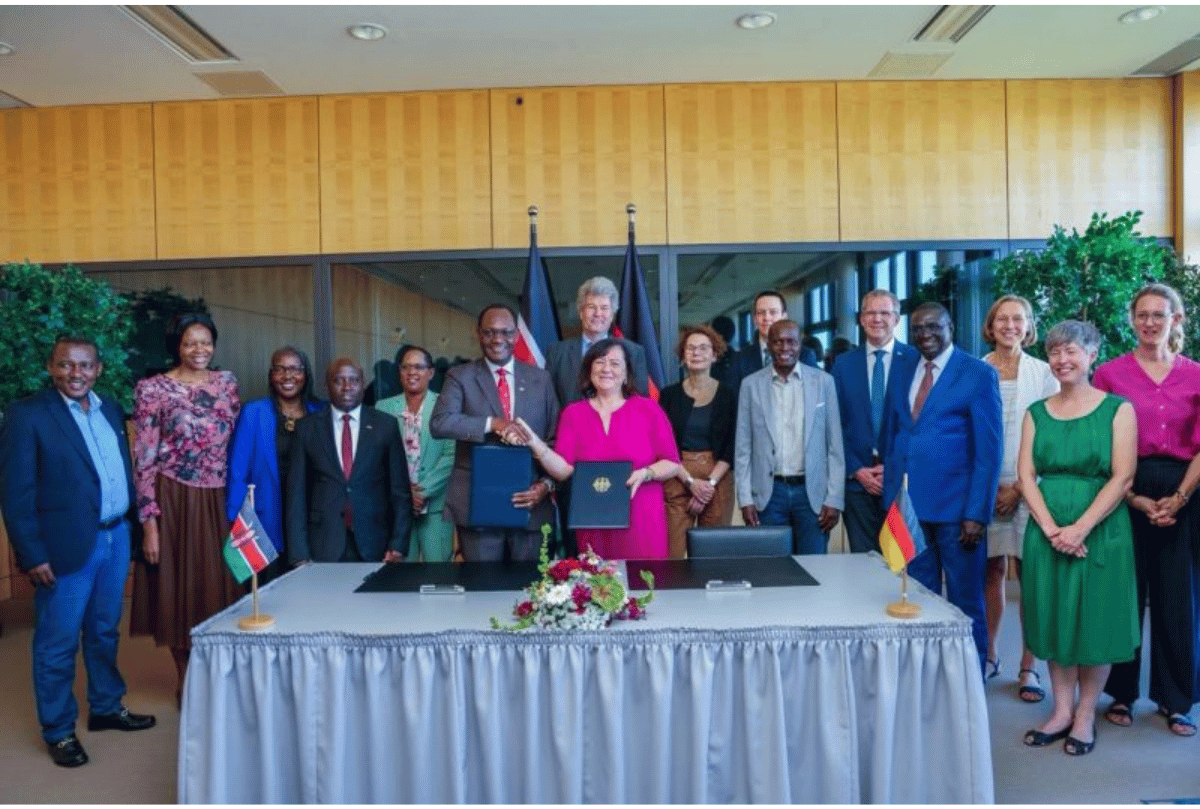
Under the new commitment, Germany will provide technical and financial cooperation funding to support several of Kenya”s national priorities, including digital transformation, private sector development, trade and investment, technical and vocational education and training, labour mobility, renewable energy, agriculture, irrigation and governance reforms.
Kenya and Germany have strengthened their development partnership with a new KSh7.8 billion cooperation package aimed at supporting digital transformation, climate action and economic development initiatives between 2026 and 2028.
The agreement was formalized during the Kenya–Germany Biennial Government-to-Government Negotiations on Development Cooperation held in Berlin. Kenyan officials, including Principal Secretary for ICT and Digital Economy John Kipchumba Tanui and National Treasury Principal Secretary Chris Kiptoo, signed the agreements alongside representatives from Germany’s Federal Ministry for Economic Cooperation and Development.
Under the new commitment, Germany will provide technical and financial cooperation funding to support several of Kenya’s national priorities, including digital transformation, private sector development, trade and investment, technical and vocational education and training, labour mobility, renewable energy, agriculture, irrigation and governance reforms.
The two countries also indicated that an additional KSh4 billion in funding for the energy sector could be considered in the coming weeks, potentially expanding the scope of the partnership.
A key component of the agreement is the second phase of the Digital Transformation Center (DTC II), which will extend cooperation until 2029. The programme will focus on advancing ethical artificial intelligence, data governance, digital public infrastructure and digital public goods while supporting the creation of digital employment opportunities.
The partnership also seeks to strengthen Kenya’s digital economy by promoting innovation, improving digital skills and supporting the development of globally competitive digital services. Efforts under the programme are expected to contribute to job creation and expand opportunities within the country’s growing technology sector.
Beyond digital transformation, the cooperation framework includes support for climate-smart agriculture, renewable energy projects, electric mobility initiatives, and programmes aimed at improving the competitiveness of Kenyan businesses.
The agreement also places emphasis on strengthening technical and vocational education, labour mobility and institutional capacity to support long-term economic growth and governance reforms.
Kenyan officials said the partnership demonstrates how collaboration between governments, development partners, the private sector and international institutions can help translate policy objectives into tangible economic and social outcomes.
As Kenya continues to pursue its digital economy agenda, the agreement with Germany is expected to support the country’s efforts to build a digitally enabled, climate-resilient and globally competitive economy.
