

Led by ORNL, the DataHub supports AI-driven workflows for lifetime prediction, anomaly detection and digital twin development using curated energy storage data
May 28, 2026 — The Department of Energy’s Rapid Operational Validation Initiative (ROVI) has reached a major milestone with the development and live demonstration of the ROVI DataHub, a secure, scalable data platform designed to unify energy storage data from across the national laboratory complex and field deployments. The DataHub will underpin DOE’s efforts to validate long-duration energy storage (LDES) technologies such as batteries and meet statutory performance reporting requirements for demonstration projects.
Credit: DOE
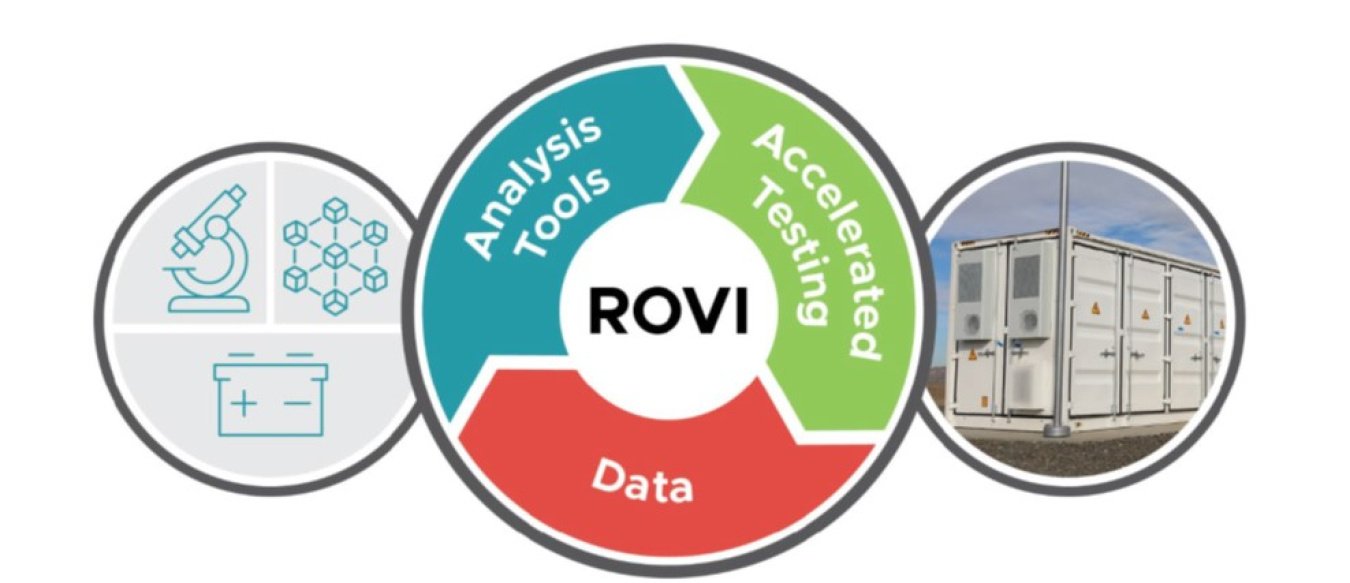
ROVI was launched in 2022 as part of DOE’s Energy Storage Grand Challenge to standardize testing, validation and lifetime prediction for emerging storage technologies. A team spanning six national laboratories — Pacific Northwest, Argonne, Idaho, Sandia, the National Lab of Rockies and Oak Ridge — is building a framework that links standardized testing, durability and safety assessment, accelerated life testing and advanced data science methods for lifetime prediction. The ROVI DataHub is the digital backbone of that framework, bridging data producers and data consumers across the program.
“Long-duration storage projects generate massive, messy data streams that have historically been locked in separate systems,” said Srikanth Allu, ROVI DataHub principal investigator at ORNL. “With the DataHub, we now have a single, secure environment where those data can be brought together, curated and turned into trusted insights for DOE, researchers and industry partners.”
Built as a secure and expandable warehouse for energy storage data, the ROVI DataHub supports both real-time streaming and batch ingestion from laboratory testbeds, pilot systems and fielded LDES projects. It also accommodates multiple data formats across lithium-ion and flow battery technologies and is designed to ingest complex metadata, event logs, synthetic datasets and characterization data from the full battery lifecycle.
This year, the team successfully demonstrated the DataHub to DOE’s Office of Electricity Energy Storage program by streaming a lithium-ion battery system from Sandia National Laboratories and redox flow battery system datasets from Pacific Northwest National Laboratory, validating the platform’s ability to federate data from multiple laboratories and sources in a single interoperable environment.
Instead of data remaining stranded in separate “silos,” the DataHub acts as a central interchange where information from energy storage developers, national lab testbeds, synthetic data from physics modeling, and characterization campaigns can be aligned, quality-checked and prepared for analysis. The system incorporates search, metadata filtering and interactive dashboards so users can discover datasets, visualize time series, and drill down from system-level views to cell- and component-level detail without needing to write custom code. As a result, the DataHub actively accelerates AI development on ROVI data for key use cases such as battery energy storage systems lifetime prediction, anomaly and fault detection and digital twin construction.
Security and governance are built in from the start. The DataHub uses encrypted upload and download, role-based user authentication, and a governance framework that emphasizes data quality, privacy, and regulatory compliance. ROVI’s data architecture defines expectations for data collection, quality assurance, versioning and lifecycle management, treating data as a product that moves through clearly defined stages of ingestion, curation and sharing. Metadata standards and ontology-based descriptions help ensure that heterogeneous datasets remain interoperable across projects and technologies.
“From the beginning, we designed the DataHub so users know what they’re looking at — where the data came from, how it was transformed and how it can be shared,” said Josh Grant, the DataHub architect. “That traceability and role-based access are essential for utilities, vendors and DOE to trust the analytics and policy decisions that will be built on top of this platform.”
Beyond storage and visualization, the ROVI DataHub is tightly coupled with advanced machine learning and AI workflows. Users can retrieve curated datasets to train models on high-performance computing systems, then upload those models back into the DataHub for inference, monitoring and decision support. The platform supports streaming analysis, incremental model updates and large-scale model training on petabyte-scale repositories, enabling everything from event detection to surrogate models that emulate complex physics-based simulations.
The DataHub’s architecture also anticipates long-term preservation and reuse. Data lifecycle strategies distinguish hot, warm, and cold storage; integrate ETL (Extract/Transform/Load) pipelines and raw data store; and provide pathways to export curated datasets to external repositories and open data facilities when appropriate. Robust archiving and versioning policies protect raw “gold standard” source data while allowing derived products and anonymized datasets to be shared more broadly with the research and stakeholder community.
As ROVI expands to support additional LDES demonstrations and technologies, the DataHub will play a growing role in delivering standardized performance metrics to DOE, supporting model development at the national laboratories and providing the evidence base needed by policy makers, investors and insurers to assess technology risk. By unifying secure data management with advanced analytics and AI, the ROVI DataHub is poised to accelerate the development, validation and deployment of next-generation energy storage systems that are critical to a reliable grid.
Support for this research came from the DOE Office of Electricity. Michael Starke of ORNL’s Energy Science and Technology Directorate managed the project.
UT-Battelle manages ORNL for DOE’s Office of Science, the single largest supporter of basic research in the physical sciences in the United States. DOE’s Office of Science is working to address some of the most pressing challenges of our time. For more information, visit https://energy.gov/science.
Source: ORNL
The post ROVI DataHub Unifies Energy Storage Data to Accelerate Long Duration Battery Innovation appeared first on AIwire.
