

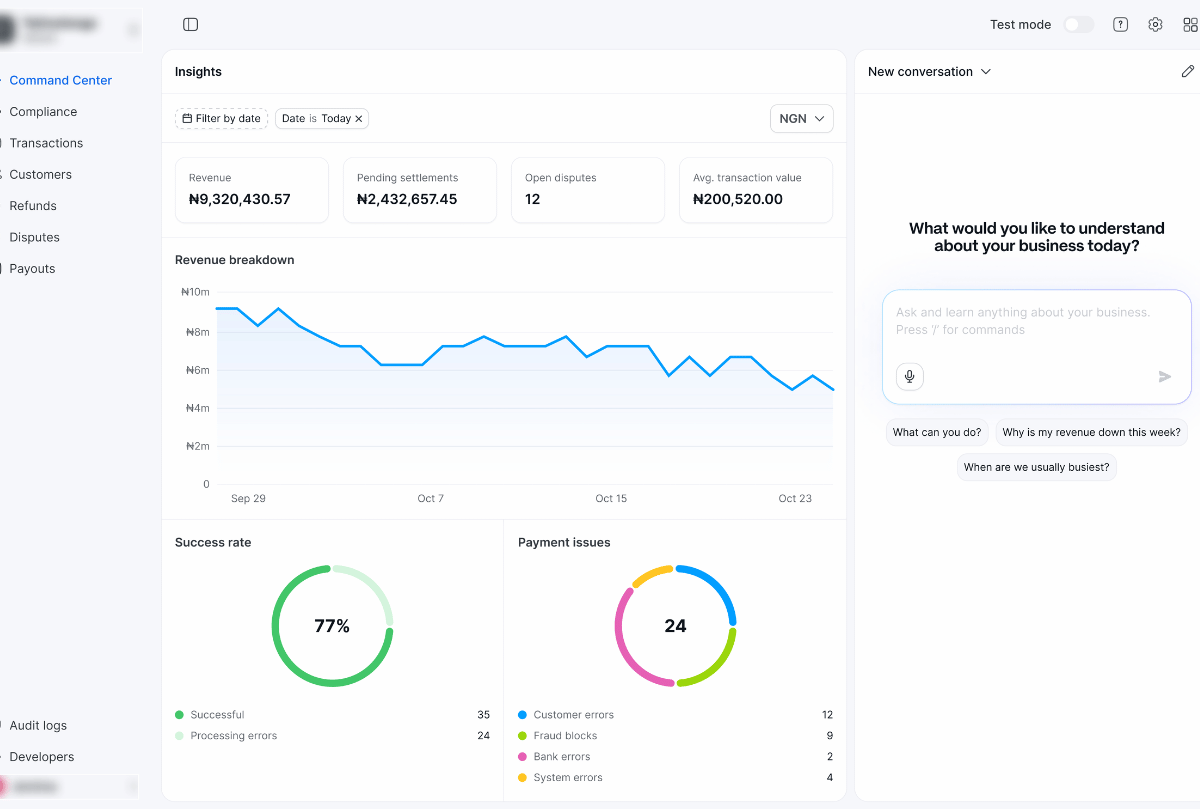
The new Dashboard has been rebuilt from the ground up to better reflect how modern businesses operate, moving beyond incremental updates to a complete rethinking of its architecture, user experience, and product direction.
Paystack has announced the launch of Canvas, a fully rebuilt version of its Dashboard, marking the first major redesign of the product in 10 years. The new Dashboard has been rebuilt from the ground up to better reflect how modern businesses operate, moving beyond incremental updates to a complete rethinking of its architecture, user experience, and product direction.
According to Paystack, the original Dashboard evolved alongside its growing merchant base, with new features and workflows added over time. While this made the platform more powerful, it also introduced complexity, making it harder for users to navigate and locate key information. The company said feedback from merchants revealed increasing difficulty in finding insights quickly, particularly as businesses now expect faster access to analytics, mobile-first functionality, and clearer decision-making tools.
A key motivation for the redesign was the shift in how merchants use the platform. More users now rely on mobile devices for day-to-day operations, while growing businesses demand deeper insights into revenue trends, disputes, and customer behavior. Paystack noted that the previous structure required multiple steps—such as filtering and exporting data—to answer basic business questions, which slowed down decision-making.
The new Canvas Dashboard introduces a simplified navigation structure built around two main sections: Payments and Products. Payments includes core functions such as transactions, customers, refunds, disputes, and settlements, while Products will house newer modular offerings like transfers and transaction splits. The redesign also introduces a cleaner interface, improved accessibility, and optional dark mode to enhance usability across devices.
A major highlight of the new system is an AI-native Command Center, which allows merchants to ask questions in natural language and receive direct answers, summaries, and visualizations based on their business data. Instead of manually navigating through dashboards and reports, users can now query the system directly—for example, asking about revenue changes, disputes, or customer activity—and receive contextual insights instantly.
Under the hood, Paystack said the system combines large language models, structured data retrieval, and internal validation layers to ensure accuracy and reliability. The company emphasized that responses are grounded in real merchant data and subject to strict safeguards to reduce errors and ensure compliance with privacy and regulatory standards.
The redesign also prioritizes mobile parity, ensuring that all features available on desktop are fully accessible on mobile devices. This reflects the growing trend of merchants managing financial operations on the go. The new system was built on Paystack’s design system, Pax, which enabled consistency across components, responsiveness across devices, and improved accessibility standards.
Paystack noted that Canvas was developed over a five-month period between late 2025 and April 2026 by a small cross-functional team spanning product, design, engineering, and data. The company also highlighted lessons learned during development, particularly around earlier adoption of AI evaluation systems to improve reliability and testing efficiency.
Looking ahead, Paystack said Canvas represents the foundation for its next phase of product development. The company plans to expand AI capabilities, refine the Command Center experience, and gradually migrate more of its product ecosystem into the new architecture. It also invited user feedback to help shape future improvements, positioning the launch as the beginning of an ongoing evolution rather than a final release.
