

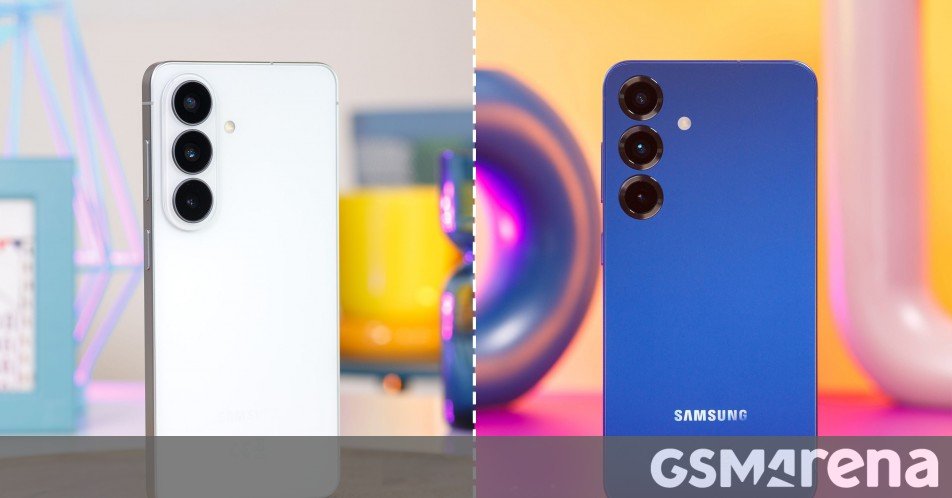
It’s time to upgrade your Galaxy, or you’ve decided that you want something fresh altogether, and the new Galaxy S26 series popped up on your radar. In case the fun-sized Samsung Galaxy S26 meets your needs, then you must definitely be considering the older Samsung Galaxy S25 as well. It’s a slightly more affordable alternative to the Galaxy S26 and offers essentially the same user experience.
If you have not been following Samsung’s Galaxy S evolution for the last few years, you might have missed the fact that upgrades each year are few and far between, which in turn pushes consumers to look into the older models, too. After all, Samsung offers 7 years of full software support, so you are not really losing much if you go for an older model.
Table of Contents:
With the S26 series, Samsung is back to the dual-chip strategy, leaving places like Europe and South Korea with the Exynos 2600, while the US, China and Japan get all the S26 phones in the Snapdragon 8 Elite Gen 5 for Galaxy flavor.
For context, last year’s S25 series was exclusively powered by the Snapdragon 8 Elite SoC, so this comparison will be particularly of interest to users deciding between the Snapdragon and the Exynos. Stick around to find out.
For starters, you can compare the complete specs sheets or directly continue with our editor’s assessment in the following text.
Size comparison
The two devices adopt a near-identical design and build. Both handsets have Gorilla Glass Victus 2 panels on the back and front, kept together by an Aluminum armor 2 frame. Dimensions and weight are also comparable, but the S26 is a bit taller due to the 0.1-inch larger display.
The only small distinction is that the newer S26 has a whole camera island that protrudes and causes the phone to wobble on a flat surface. The S25 has a somewhat cleaner design. Then again, some may prefer the S26 over the S25.
Display comparison
There are no surprises in the display department this year either. The two handsets share the same LTPO OLED panel, offering a 120Hz refresh rate with granular control and almost 1,400 nits maximum brightness. The 0.1-inch increase in size can easily go unnoticed.
The lack of upgrade in the display department isn’t a huge drawback, though, as the one used in the previous two generations is perfectly fine.
Battery life
The newer Galaxy S26 gets a modest increase in battery capacity over last year’s model, which partially explains the uptick in endurance. There could be some additional software and hardware optimizations involved as well, but regardless of the reason, the S26 is the one with longer battery life.
The two handsets seem to score similarly in the call and gaming tests, but the S26 pulls ahead of the S25 in the other two screen-on scenarios – web browsing and video streaming. The gains are not negligible either.
Charging speed
On paper, the two Galaxy phones should have comparable charging times. They both support up to 25W wired fast charging over Power Delivery, even though Samsung says the newer Galaxy is five percentage points faster in the first 30 minutes of charging.
However, our tests show a more significant improvement. The S26 turned out to be markedly faster at the 15-minute and 30-minute checkpoints. It also charged much faster to 100%. We believe that Samsung applied a more aggressive charging curve this time around.
There are no upgrades to the wireless charging – both devices support up to 15W over Qi2, and they both require magnetic cases to be paired with magnetic wireless charging accessories.
Speaker test
The newer speakers are just a tad quieter compared to the S25’s, but they also sound better. They bring more depth and more pronounced bass without overpowering the vocals. The S25 sounds flatter in comparison.
Performance
The performance section is likely the most interesting one, as this is the only meaningful hardware change. The entire world got a Snapdragon 8 Elite-powered Galaxy S25 last year, while this time, the US, China and Japan get the Snapdragon 8 Elite Gen 5 for Galaxy S26. The rest of the world gets the new Exynos 2600.
One key distinction between the two chipsets is that the Exynos 2600 is based on a 2nm manufacturing process, while the SD8 Elite is 3nm. Also, the Exynos uses an AMD-designed Xclipse 960 GPU, while the Snapdragon relies on an in-house Adreno 830 GPU.
While the Galaxy S25’s default storage option is 128GB, the S26 starts from 256GB in most markets. You can still find a 128GB version, but it’s not widely available. Unfortunately, the upgrade comes at a cost. The 256GB storage variant last year was $40/€40 cheaper. All storage configurations are fitted with 12GB memory on both phones.
Benchmark performance
The synthetic benchmarks suggest that the Exynos 2600 is indeed more powerful than last year’s Snapdragon 8 Elite. However, the gains are rather modest.
In the CPU-bound Geekbench 6, the Exynos 2600 shows an 8% difference, and so does the GPU-intensive 3DMark Wild Life Extreme test. The combined AnTuTu 10 test gives an 11% edge over the SD8 Elite.
Camera comparison
The Galaxy S26 cameras have remained unchanged compared to last year’s model – even more so than the Ultra and even more so than the S26+. All three modules on the back report the same hardware, down to the sensor model names (at least for the main camera and the telephoto – the ultrawide camera’s sensor isn’t specified).
It’s a 1/1.56″ optical format sensor on the main camera with a 50MP nominal resolution, paired with a stabilized 23mm-ish lens. The telephoto camera uses the same sensor as last year, the 3K1 (from comparison, the Plus and the Ultra have the same size imager, at 1/3.94″, but a different model). The ultrawide camera’s sensor is a conventional RGB unit with a 1/2.55″ optical format and there’s still no autofocus on this camera.
The one new bit, and it’s an important one, is the lens on the selfie camera – all the S26s get a 23mm equivalent lens in place of the 25-26mm ones on the older models.
Image quality
Daylight
Main camera daylight photos are quite similar, but the new model does show a bit of warming up in its color rendition, particularly noticeable in greenery. You could say that the S26’s detail has a finer structure and less intense sharpening too.








Daylight comparison, main camera (1x): Galaxy S26 • Galaxy S25
The color differences remain at 2x, but the detail rendition discrepancy gets smaller to non-existent in outdoor shots, while it’s the S25 that deals better with dimmer indoor scenes.








Daylight comparison, main camera (2x): Galaxy S26 • Galaxy S25
At 3x zoom, you can expect to see the same detail presentation from both phones, but the S26 still insists on warmer greenery (which is a good thing, probably?).








Daylight samples, telephoto camera (3x): Galaxy S26 • Galaxy S25
Looking at some ultrawide shots, there’s a hint of that same yellowish green tendency, but it’s not as pronounced. Detail is practically the same between the two phones.








Daylight comparison, ultrawide camera (0.6x): Galaxy S26 • Galaxy S25
Low light
The Galaxy S26 adopts Samsung’s new approach to low-light processing with no immediately available dedicated night mode. You do get the auto night mode action in Photo mode, which isn’t particularly convincing – it doesn’t always engage, and oftentimes when it does engage, it’s not the best of results – and in some scenes the full auto photos aren’t great. The S25 is also not the most dependable of low-light shooters.
The main cameras’ results in full auto are broadly similar between the two, with little noise reduction applied, plenty of grain, and not particularly great sharpness. Maybe the S26’s shots are slightly better in some ways, but the S25 has its small advantages here or there – we’re not really convinced.








Low-light comparison, main camera (1x): Galaxy S26 • Galaxy S25
The S26 can be prone to color shifts if you get it to max out its auto night mode. The S25 is somewhat more dependable.








Low-light comparison, main camera (1x), max night mode: Galaxy S26 • Galaxy S25
There are some nuances in the 2x results, but neither is a clear winner and you’d be getting a liberal amount of noise either way.








Low-light comparison, main camera (2x): Galaxy S26 • Galaxy S25
The max auto night mode on the S26 produces somewhat better results than the S25’s standalone Night mode shots, which can be pretty artificial.







Low-light comparison, main camera (2x), max night mode: Galaxy S26 • Galaxy S25
Similarly, the 3x results aren’t looking great from either phone, though they strike different balances with their sharpening and noise reduction choices. We just might prefer the S25’s takes.








Low-light samples, telephoto camera (3x): Galaxy S26 • Galaxy S25
With more intense night processing, things are headed towards a toss-up.








Low-light samples, telephoto camera (3x), night mode: Galaxy S26 • Galaxy S25
On the ultrawide cameras, we’re seeing the two phones trade victories from scene to scene when shooting in full auto.








Low-light comparison, ultrawide camera: Galaxy S26 • Galaxy S25
If you’re more deliberate with the S26’s night mode, you’d probably be able to get better results than the S25’s night mode efforts, with some degree of consistency.








Low-light comparison, ultrawide camera, night mode: Galaxy S26 • Galaxy S25
Selfies
Last year’s Galaxy had a great selfie camera, but the one on the S26 is even better – one of the few notable changes to the 2026 model. We’re getting sharper images on the S26 and the wider coverage now (23mm vs 25/26mm lens) makes the new camera even more versatile.




Selfies comparison: Galaxy S26 • Galaxy S25
Video quality
Not a lot has changed in the video recording department – the S26 will give you Horizon lock stabilization and LUTs for real-time preview in Log recording. Other than that, both phones offer identical video recording capabilities, with 4K60 on all cameras, 8K30 on the main rear ones, and decently capable Pro video modes.
Video quality in daylight is virtually the same. Minute differences in color rendition or sharpening can be spotted after staring long enough at side-to-side comparisons, but those are entirely immaterial.




Daylight video screengrabs, Galaxy S26: 0.6x • 1x • 2x • 3x




Daylight video screengrabs, Galaxy S25: 0.6x • 1x • 2x • 3x
In the dark, there are some more notable differences. The S26 has an edge in sharpness on the ultrawide, while the S25 is meaningfully better at 3x. The main cameras are broadly comparable.




Low-light video screengrabs, Galaxy S26: 0.6x • 1x • 2x • 3x




Low-light video screengrabs, Galaxy S25: 0.6x • 1x • 2x • 3x
Verdict
As you can see, the newer Galaxy S26 is nominally better than the Galaxy S25 but only in some aspects. The new model is faster to charge, has better battery life and offers a modest increase in raw performance. But then, the display, camera hardware and design are practically the same. It’s more of a refresh, not a generational upgrade.
Hence, we don’t believe the roughly €150/$150 price gap is justifiable. The Galaxy S25 just feels like the more sensible pick between the two, offering a near-identical user experience for less money.
- The longer battery life.
- The better speakers.
- The slightly faster charging.
- The slightly more powerful chipset.
- The wider and sharper selfies.
- The LUTs in Log video recording, Horizon lock stabilization
Get the Samsung Galaxy S26 for:
- The lower price tag.
- The largely similar user experience.
Get the Samsung Galaxy S25 for:
