

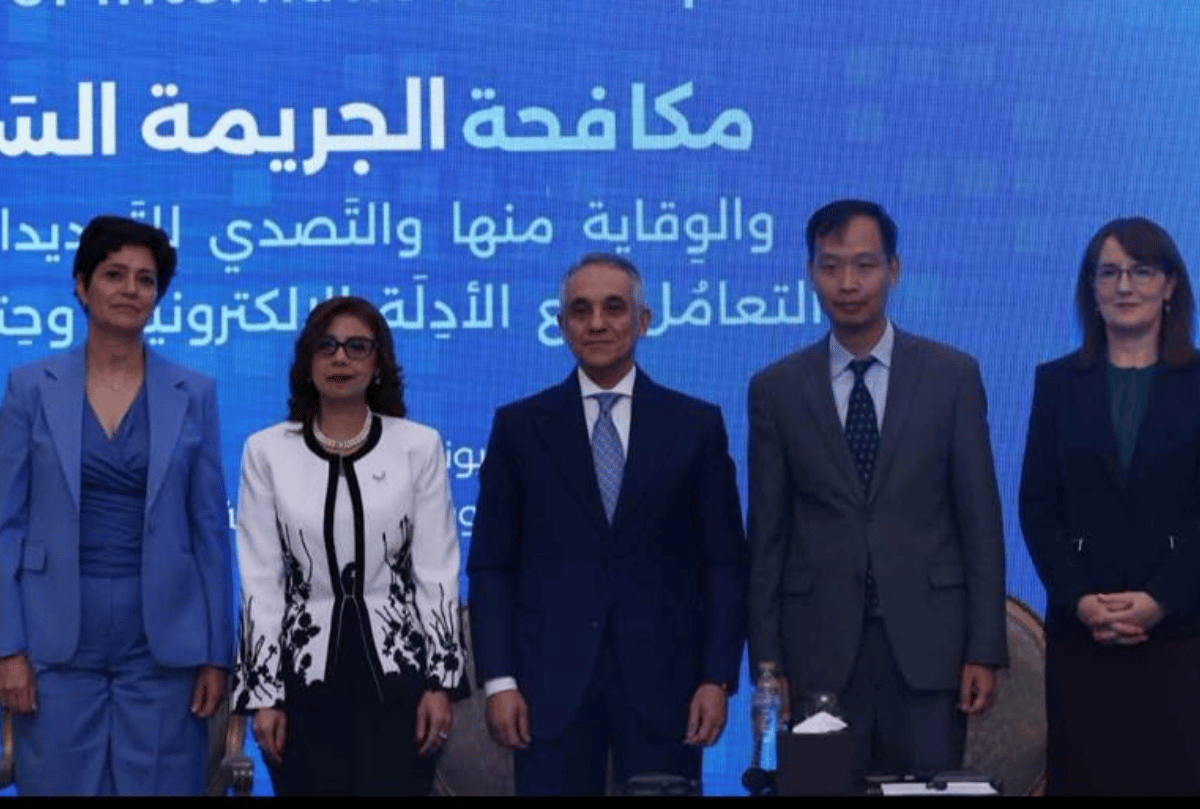
The conference aims to enhance international cooperation, highlighting the newly adopted United Nations Convention against Cybercrime and discussing its implications for national legislative frameworks, and reviewing complementarities and coherences between them and regional conventions, in order to ensure the establishment of a unified international legal framework to govern access to electronic evidence and facilitate its exchange in transnational investigations.
On Sunday, 6/14/2026, Counselor Mahmoud Helmy Al-Sharif, Minister of Justice, inaugurated the activities of the International Conference on “Combating and Preventing Cybercrime, Countering Emerging Threats, Dealing with Electronic Evidence and the Imperative of International Cooperation”, organized by the Egyptian Ministry of Justice in partnership with the United Nations Office on Drugs and Crime and the Council of Europe, and in cooperation with the Faculty of Law at the British University in Egypt, on June 14 and 15.
The opening session was attended by the Minister of Parliamentary Affairs, the President of the Court of Cassation, the President of the Supreme Judicial Council, the First Deputy President of the Court of Cassation, the Member of the Supreme Judicial Council, the President of the Cairo Court of Appeal, the Member of the Supreme Judicial Council, the President of the Administrative Prosecution Authority, the representative of the European Union, the Ambassador of Vietnam to Egypt, the Deputy Assistant Minister of Foreign Affairs for the Specialized International Bodies, the Deputy Regional Representative of the United Nations Office on Drugs and Crime for the Middle East and North Africa, the Head of the Cybercrime Section of the Council of Europe, and the Dean of the Faculty Law at the British University in Egypt, and ambassadors of Arab and foreign countries. Representatives of judicial and investigative authorities and law enforcement agencies from various Arab, African and European countries, as well as academics and experts specialized in the field of combating cybercrime, will participate in the conference.
At the beginning of the conference’s activities, the Minister of Justice welcomed the attendees in his speech, and expressed his pride in the holding of this conference, which comes within the framework of strategic cooperation that brings together the Egyptian Ministry of Justice with an elite of international and academic partners. In his speech, the Minister stressed that confronting cybercrime has become a shared responsibility that is not carried out by a single state alone, nor is it independent of an institution in isolation from others, stressing that international cooperation is the best way to confront a cross-border threat that does not leave countries with the luxury of working alone.
He pointed out that the world is witnessing an accelerated digital transformation that has produced new patterns of organized crime that transcend borders and are hidden behind complex technologies that are beyond the ability of traditional systems to prosecute. He warned of the widening circles of danger with the possibility of harnessing artificial intelligence in committing these crimes, pointing out that the most painful impact extends to children, women and the most vulnerable groups, which requires institutional vigilance and a quick response to deal with the electronic manual, which does not tolerate slow procedures.
He also stressed the great importance of the conference as a platform for exchanging best practices and moving from the stage of adherence to international conventions to practical mechanisms for implementation. He reviewed the historical legal reference from the Budapest Convention, the Arab Agreement, and the African Union Malabo Convention, to the United Nations Convention against Cybercrime signed in Hanoi, which represents a pioneering step to build a comprehensive global framework that consolidates criminal justice in the digital age.
In this context, he reviewed the pivotal role of the Egyptian Ministry of Justice in modernizing work mechanisms and capacity building, which culminated in the launch of the ‘Egyptian-African Center for the Prevention and Combating of Cybercrime’ in cooperation with the United Nations Office on Drugs and Crime (UNODC), to be a leading regional platform to support the countries of the African continent in the Facing the challenges of the digital space.
For her part, Ms. Anne Xu, Deputy Head of the EU Delegation to Egypt, warned of the staggering increase in the pace of cybercrime, which is estimated to size more than $10 trillion annually to become the third largest economy in the world, and attributed this growth to the lax use of everyday AI technologies without the necessary protection measures. She stressed that facing this current challenge represents the essence of the new agreement and the focus of the conference, stressing the strategic importance of integration between international conventions to unify efforts and formulate a decisive and transcontinental cyber deterrent.
Mr. Nguyen Nam Duong, Ambassador of Vietnam to Egypt, also delivered a speech in which he stressed the imperative of strengthening international cooperation to combat cybercrime, which affects all countries and faces the ambitions of digital transformation as a locomotive of economic growth, reviewing his country’s efforts in capacity building and human resources rehabilitation in cooperation with the United Nations Office on Drugs and Crime (UNODC). The Ambassador unveiled a pioneering initiative launched by Vietnam with the United Nations Secretariat on April 17, 2026 as the world’s first joint investigation model, stressing that the ultimate goal is to transform international cooperation into a practical umbrella that contributes to promoting secure digital communication and making the cyber environment safer and legally accountable.
For her part, Ambassador Amira Fahmy, Deputy Assistant Minister of Foreign Affairs for Specialized International Bodies, expressed her great appreciation for participating in this conference, which is hosted by the Egyptian Ministry of Justice as the most prominent event in the world following the adoption of the Cybercrime Convention by the United Nations. She warned that cybercrime has become one of the most serious global cross-border threats that affect the daily lives of citizens and affect the stability and economies of countries, pointing out that it targets developing countries in particular, taking advantage of the huge disparity in technical capabilities.
In her speech, she praised Egypt’s pivotal and leading role in the formulation of the agreement negotiations since 2021, pointing to Egypt’s success in achieving its priorities, which focused on expanding the scope of criminalization, upholding the principle of national sovereignty and preventing interference in internal affairs. She also praised Egypt’s efforts in supporting technology transfer and building the capacities of developing countries to bridge the digital divide, achieve a delicate balance between national security considerations, safeguarding human rights and freedoms, and taking into account the cultural specificities of countries.
Ms. Mirna Bou Habib, Deputy Regional Representative of the United Nations Office on Drugs and Crime (UNODC), praised the leading role of the Egyptian Ministry of Justice in developing the criminal justice system, stressing that the conference is one of the first events following the adoption of the historic United Nations Convention on Drugs and Crime (UNODC), which unifies efforts under the umbrella of a binding global instrument, and announced the Office’s readiness to provide legislative and technical support to all countries. It warned of the seriousness of the new patterns of cybercrime enhanced by artificial intelligence and cryptocurrencies, stressing the centrality of electronic evidence in identifying perpetrators, and calling for the modernization of procedural measures and the development of rapid exchange of information while strictly adhering to human rights guarantees and a fair trial.
In her speech, Ms. Ashling Kelly, Head of the Cybercrime Section at the Council of Europe, praised Egypt’s pioneering participation and its ability to lead international efforts, stressing the need for criminal justice to accelerate its response, and announcing that the Council will issue a comprehensive study this year that monitors the practices of more than 25 countries on artificial intelligence in cybercrime. She stressed the imperative of establishing multilateral cooperation based on the rule of law, pointing out that the security of countries is linked to citizens’ confidence in the efficiency of the judicial system and the accountability of criminals, and warned that the decline of deterrence in the era of artificial intelligence threatens societal trust in the digital environment.
In a related context, Prof. Dr. Ibrahim Salama, Dean of the Faculty of Law at the British University in Egypt, stressed that this high-level international gathering represents a qualitative and conscious leap in the path of comprehensive international cooperation, pointing out that the Egyptian Ministry of Justice was the main pillar that managed the Egyptian position and national discussions during all stages of negotiations on the agreement, to prepare today to start a new and significant phase represented in the actual transition from the negotiation frameworks to the stage of acceptance and implementation on the ground.
In his speech, he explained that this conference is an integral part of a sustainable strategy for capacity building, which ensures the continuation of the pivotal role and joint efforts of the Egyptian Ministry of Justice, the United Nations Office on Drugs and Crime (UNODC), and partner academic institutions, led by the British University. He pointed out that confronting cyber terrorism has been and continues to be the focus of great and early attention, as it provides a very rich and valuable opportunity to tighten control and protect cybersecurity.
The conference will be held in a panel discussion system, and moderated by a group of speakers representing the Ministries of Justice, investigative and judicial authorities, law enforcement agencies, experts from relevant international and regional organizations, and academic and research institutions, through which the topic of emerging cyber threats, including crimes driven by artificial intelligence technologies, dark web markets, and combating extortion and sexual exploitation of children online, will be discussed, in conjunction with a review of the Egyptian state’s response to cybercrime, and institutional progress in strategies Prosecution and national coordination of the criminal justice system.
The conference also aims to enhance international cooperation, highlighting the newly adopted United Nations Convention against Cybercrime and discussing its implications for national legislative frameworks, and reviewing complementarities and coherences between them and regional conventions, in order to ensure the establishment of a unified international legal framework to govern access to electronic evidence and facilitate its exchange in transnational investigations.
The Ministry of Justice, through the organization of this high-level international forum, emphasizes Egypt’s leading role and regional influence in supporting and activating regional and international coordination and cooperation frameworks, enhancing the process of capacity building and exchanging experiences and best practices, especially within the framework of activating the work of the “Egyptian-African Center for the Prevention and Combating of Cybercrime” in partnership with the United Nations Office on Drugs and Crime (UNODC), in order to consolidate the development of preventive measures and the necessary legislative reforms, and to support development efforts in various fields by creating a digital environment that enjoys security and trust.
